Teacher, Trainer, Consultant, Coach, or Mentor? The Real Difference
Teacher, Trainer, Consultant, Coach, or Mentor? The Real Difference
In the coaching and consulting industry, five words are used everywhere:
Teacher. Trainer. Consultant. Coach. Mentor.
And unfortunately, people often use these words interchangeably.
Someone creates a course and calls himself a Coach.
Someone conducts a webinar and calls himself a Mentor.
Someone gives advice and calls himself a Consultant.
Someone shares his experience and calls himself a Coach.
Someone teaches a skill and calls himself a Mentor.
This creates a lot of confusion.
So, let us remove the noise and look at these roles in a strict and practical sense.
I am Sunil Chaudhary, Digital Coach Business Mentor, and in this article, I want to explain the difference in very simple English.
Not according to marketing language.
Not according to fancy titles.
But according to what the professional actually does for the client.
The Simplest Difference
Here is the easiest way to understand it:
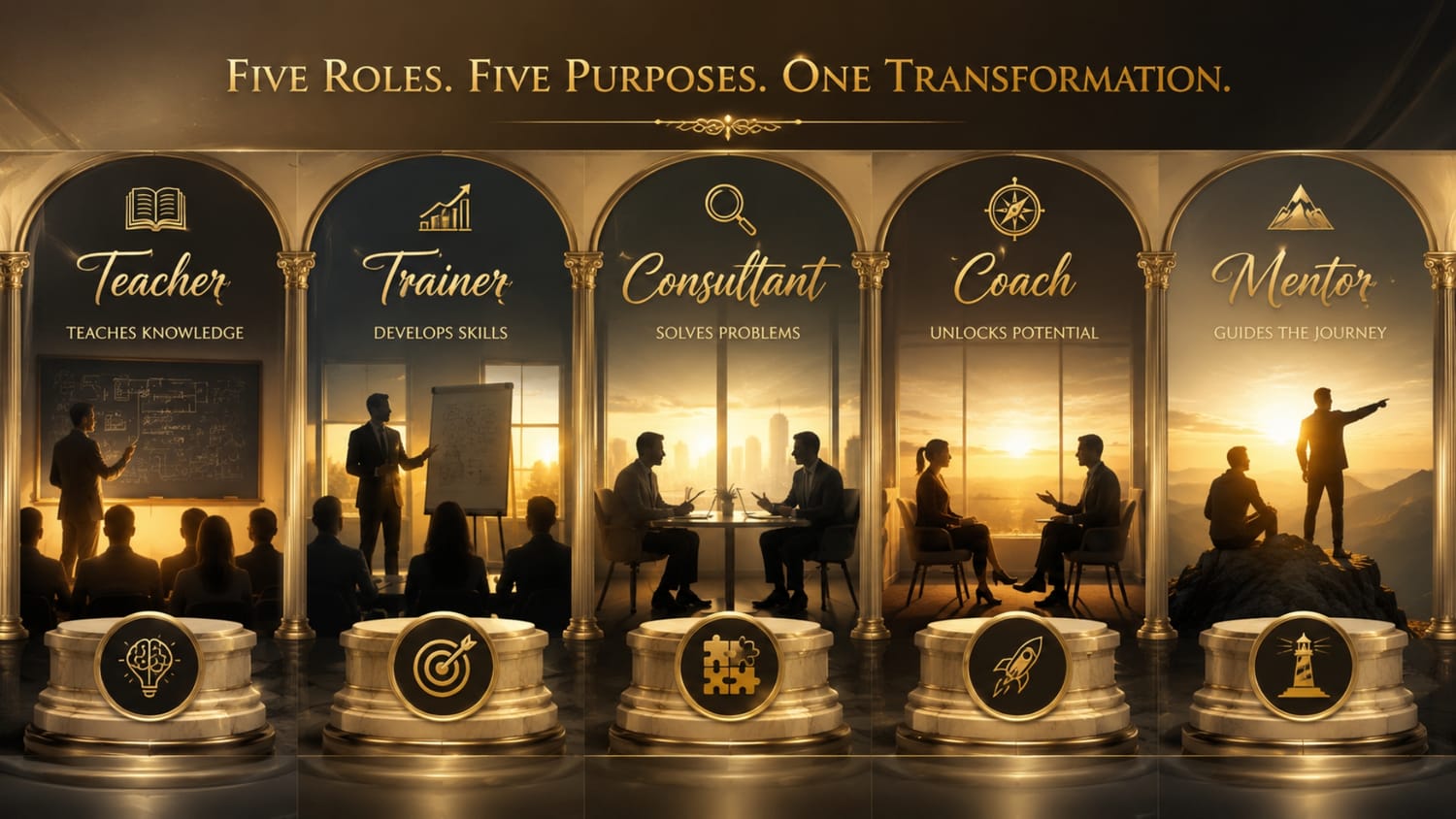
Teacher gives knowledge.
Trainer develops skills.
Consultant provides solutions.
Coach facilitates transformation.
Mentor provides experienced guidance.
That sounds simple.
But the real difference becomes clear when we look at each role deeply.
1. Who Is a Teacher?
A Teacher primarily transfers knowledge.
The teacher knows something that the learner does not know and helps the learner understand it.
The focus is on:
Knowledge
Concepts
Information
Understanding
Theory
Principles
Subject expertise
A teacher may say:
“Let me explain how SEO works.”
Or:
“Let me teach you how digital marketing works.”
The teacher's primary responsibility is to teach the subject clearly.
Example
Suppose I create a recorded course called:
“Digital Marketing Fundamentals.”
I explain:
SEO
Social Media Marketing
Email Marketing
Funnels
Content Marketing
Paid Advertising
The students watch the lessons and learn.
I am acting as a Teacher.
I don't necessarily know what every student is doing after watching the course.
I may not know:
What business they have
What their current problems are
What they implemented
Whether they implemented anything
What results they generated
That does not make the teaching less valuable.
It simply makes the role teaching, not necessarily coaching.
The Teacher's Core Question
“What do you need to know?”
2. Who Is a Trainer?
A Trainer goes one step beyond knowledge.
The trainer focuses on skill development and practice.
A teacher may explain:
“This is how you create a sales funnel.”
A trainer may say:
“Now create your funnel. Let me show you how to do it.”
Training is generally more practical.
The trainer helps people develop the ability to perform a specific task.
Examples include:
Sales training
Public speaking training
SEO training
Leadership training
Software training
Communication training
Digital marketing training
Teacher vs Trainer
A teacher may explain:
“Here are the principles of public speaking.”
A trainer may make you:
“Stand up and deliver a three-minute speech.”
The teacher focuses more on understanding.
The trainer focuses more on skill and performance.
The Trainer's Core Question
“What skill do you need to develop?”
3. Who Is a Consultant?
Now the relationship changes significantly.
A Consultant is not primarily there to teach you everything.
The consultant is brought in because you have a specific problem.
The consultant studies your situation and provides recommendations or solutions.
For example:
You have a business.
Your website is getting traffic but not generating leads.
You hire an SEO consultant.
The consultant studies:
Your website
Keywords
Content
Competitors
Technical SEO
Conversion structure
Then the consultant tells you:
“Here are the problems. Here is what I recommend you change.”
The consultant's value comes from diagnosis and expertise.
Consultant's Core Question
“What is wrong, and what should be done about it?”
A consultant can be highly personalized.
In fact, personalization is an important part of good consulting.
But consulting and coaching are still different.
4. Who Is a Coach?
Now we come to the most misunderstood word.
A Coach is not simply someone who teaches you.
A Coach works with you to help you move from your current state to a desired state.
The focus is on:
Clarity
Decisions
Action
Behaviour
Accountability
Progress
Reflection
Performance
Transformation
A Coach does not necessarily give you all the answers.
Instead, a good Coach helps you:
Understand your situation
Identify obstacles
Make better decisions
Take action
Review progress
Correct your approach
Stay accountable
Move toward your desired outcome
A Simple Example
Imagine you want to build a Digital Coaching Business.
A Teacher may teach you:
“Here are the fundamentals of digital coaching.”
A Trainer may teach you:
“Here is how to build your funnel.”
A Consultant may tell you:
“Your funnel is broken at these three points. Fix these things.”
A Coach may ask:
“What exactly are you trying to achieve? What have you done so far? What is stopping you? What action will you take this week? What happened after you took that action?”
Then the Coach reviews your progress and helps you adjust.
That is coaching.
The Coach's Core Question
“What needs to change, and how can I help you move toward that change?”
5. Who Is a Mentor?
This is where things become even more interesting.
A Mentor is primarily someone who provides guidance based on experience, wisdom, perspective and long-term understanding.
A mentor does not simply say:
“Here is what you should learn.”
A mentor may say:
“I have been through this journey. I have seen this problem before. Based on your situation, this is the direction I would recommend.”
Mentorship is usually more relationship-driven and experience-driven than teaching.
The mentor may help you understand:
What decisions to make
What mistakes to avoid
Which opportunities to pursue
Which opportunities to ignore
How to think about your career or business
How to navigate difficult situations
The Mentor's Core Question
“Based on where you are and what I have experienced, what direction will serve you best?”
The Important Difference Between Coaching and Mentoring
This distinction is extremely important.
A Coach does not have to be your mentor.
And a Mentor does not have to be your Coach.
A Coach may help you discover your own answers.
A Mentor may tell you:
“If I were in your position, I would do this.”
A Coach may ask:
“What do you think is the best decision?”
A Mentor may say:
“I have made this mistake before. I strongly recommend that you avoid it.”
Both are valuable.
But they are different roles.
Can a Recorded Course Make Someone a Coach?
Not necessarily.
A recorded course can make someone a:
Teacher.
If the course teaches practical skills, it can also be:
Training.
But a recorded course alone does not automatically create a coaching relationship.
Why?
Because coaching requires interaction around the person's specific situation, decisions, actions and progress.
If 10,000 people watch the same recorded videos, the content may be excellent.
But watching the same content does not mean 10,000 people are receiving individual coaching.
This distinction is important.
Content delivery is not automatically coaching.
Can a Large Group Class Be Coaching?
Yes.
But there is an important condition.
Group coaching can absolutely be real coaching.
A Coach does not need to sit privately with every client every day.
However, the group coaching environment should still contain meaningful coaching elements such as:
Diagnosis
Individual or contextual feedback
Questions around real situations
Accountability
Progress review
Implementation review
Course correction
Personal development
Measurable movement toward outcomes
If 2,000 people attend a session and the facilitator teaches the same lesson to everyone, that is primarily group teaching or training.
If the facilitator continuously works with participants on their specific situations, decisions, implementation and progress, then it becomes much closer to group coaching.
The difference is not the number of people.
The difference is the nature of the interaction.
Hot Seat Does Not Automatically Mean Coaching
This is another important distinction.
Many programs use the term:
Hot Seat Coaching.
A participant comes forward.
The expert asks questions.
The expert gives advice.
The participant gets feedback.
That can absolutely be coaching.
But one hot seat does not automatically mean the entire program is a coaching program.
If 2,000 people are attending and only a few participants receive individual review while the remaining participants simply watch, the overall delivery model may still be predominantly education-led.
The hot seat is a technique.
It is not, by itself, proof of a complete coaching system.
The Five Roles Compared
Role
Primary Purpose
Main Focus
Typical Question
Teacher
Transfer knowledge
Understanding
What do you need to know?
Trainer
Build skills
Practice & performance
What skill do you need to develop?
Consultant
Solve problems
Diagnosis & recommendation
What should you do?
Coach
Facilitate transformation
Action & accountability
What needs to change?
Mentor
Provide experienced guidance
Wisdom & direction
What direction would serve you best?
One Person Can Be All Five
This is perhaps the most important point.
A professional does not have to choose only one identity.
A person can be:
Teacher + Trainer + Consultant + Coach + Mentor.
For example, I may teach you digital marketing.
That makes me a Teacher.
I may train you to build funnels.
That makes me a Trainer.
I may audit your funnel and tell you what is wrong.
That makes me a Consultant.
I may work with you on your goals, implementation and accountability.
That makes me a Coach.
And if I use my years of business experience to guide your long-term decisions and help you avoid mistakes, I am acting as a Mentor.
The important thing is not the title.
The important thing is:
What role am I actually performing at that moment?
The Biggest Problem in the Coaching Industry
Today, many people use the word Coach because it sounds better commercially.
A course creator becomes a Coach.
A motivational speaker becomes a Coach.
A trainer becomes a Coach.
A consultant becomes a Coach.
A YouTuber becomes a Coach.
Someone who has achieved success becomes a Coach.
But success in one area does not automatically make someone a Coach.
Teaching is not automatically coaching.
Experience is not automatically mentorship.
Giving advice is not automatically consulting.
And conducting a live class is not automatically coaching.
The role should be defined by the service being delivered, not just by the title written in the Instagram bio.
My Strict Definition
If I had to define these five roles in one sentence each, I would say:
Teacher
I help you understand.
Trainer
I help you learn how to do.
Consultant
I diagnose your situation and recommend what to do.
Coach
I help you move from where you are to where you want to be through an intentional process of action, reflection, accountability and improvement.
Mentor
I use my experience, wisdom and perspective to guide your journey and help you make better long-term decisions.
That is the distinction I personally find most useful.
Why This Difference Matters
This is not just about terminology.
It matters because clients buy different outcomes from different professionals.
If I need knowledge, I need a Teacher.
If I need a skill, I need a Trainer.
If I have a specific business problem, I may need a Consultant.
If I need structured transformation and accountability, I need a Coach.
If I need experienced perspective and long-term direction, I need a Mentor.
Sometimes I need all five.
And sometimes one professional can provide all five services.
But I should know which hat that professional is wearing.
The Final Test
Here is my favourite test.
Don't ask:
“What does this person call himself?”
Ask:
“What exactly happens after I become their client?”
Do I receive information?
Teacher.
Do I practice a skill?
Trainer.
Do they analyse my problem and recommend solutions?
Consultant.
Do they work with me on my actions, progress, accountability and transformation?
Coach.
Do they use their experience and long-term perspective to guide my journey?
Mentor.
That is a much more honest way to evaluate the coaching industry.
My Philosophy as a Digital Coach Business Mentor
I believe the coaching industry does not need more fancy titles.
It needs clearer definitions and better delivery.
If you call yourself a Coach, then ask yourself:
Am I actually coaching?
If you call yourself a Mentor:
Am I actually providing meaningful guidance based on understanding and experience?
If you call yourself a Consultant:
Am I actually diagnosing and solving specific problems?
If you call yourself a Trainer:
Am I actually developing skills?
And if you call yourself a Teacher:
Am I actually helping people understand?
There is absolutely nothing wrong with being a Teacher.
There is nothing wrong with being a Trainer.
There is nothing wrong with being a Consultant.
There is nothing wrong with being a Mentor.
And there is nothing wrong with being a Coach.
The problem starts when the title promises something that the delivery does not provide.
That is where clarity matters.
That is where integrity matters.
And ultimately, that is where results matter.
Final Thought
Don't choose a title because it sounds impressive. Choose a role because your delivery deserves it.
A Teacher transfers knowledge.
A Trainer builds capability.
A Consultant solves problems.
A Coach facilitates transformation.
A Mentor provides experienced direction.
Know the difference. Deliver the difference. And let your results prove the difference.
Sunil Chaudhary
Digital Coach Business Mentor
Who Is a Teacher? Understanding the Real Role of a Teacher
A Teacher is a person who helps others gain knowledge, understanding, and awareness about a particular subject.
In simple words:
A Teacher helps you understand what you did not know before.
That is the core responsibility of a Teacher.
A Teacher does not necessarily need to change your life, build your business, monitor your implementation, or take responsibility for your results.
The primary job is much simpler and equally important:
Teach. Explain. Clarify. Demonstrate.
What Does a Teacher Actually Do?
A Teacher typically has knowledge or expertise in a particular subject and transfers that knowledge to students.
For example, a Teacher may teach:
Mathematics
English
Science
History
Digital Marketing
SEO
Business
Psychology
Communication
Leadership
Technology
The Teacher creates an environment where the learner can understand a subject more clearly.
A good Teacher can simplify complex ideas.
For example, instead of explaining SEO using complicated technical language, a good SEO Teacher may say:
“Google needs to understand what your page is about before it can confidently show it to the right person.”
The student now understands the basic concept.
That is teaching.
The Primary Objective of a Teacher
The primary objective of a Teacher is:
Knowledge Transfer.
The Teacher moves information, concepts, frameworks, principles, and understanding from one person to another.
The Teacher's fundamental question is:
“What does this person need to understand?”
This is different from the fundamental question of a Coach.
A Coach may ask:
“What is stopping this person from achieving the desired result?”
A Teacher asks:
“What does this person not know yet?”
That is a major difference.
Teacher Is Not Responsible for Every Result
This is where people often misunderstand the role.
Suppose I teach you SEO.
I explain:
Keyword research
On-page SEO
Technical SEO
Content strategy
Internal linking
Backlinks
Search intent
You now have the knowledge.
But what happens next?
You may implement it.
You may not implement it.
You may implement it incorrectly.
You may implement it perfectly.
You may generate traffic.
You may generate no traffic.
The Teacher has still performed the teaching function if the knowledge was effectively transferred.
Of course, a great Teacher cares about whether students understand the material.
But the Teacher is not automatically responsible for personally monitoring every student's implementation and business outcome.
That would move the relationship toward training, consulting, coaching, or mentoring.
Teacher vs Coach
This is one of the most important distinctions.
A Teacher may say:
“Here is how you build a sales funnel.”
A Coach may say:
“Show me the funnel you built. Let's understand what is happening, identify the bottleneck, decide what you will change, and review the result.”
The Teacher provides knowledge.
The Coach works around the individual's journey toward a desired outcome.
Teacher:
Knowledge → Understanding
Coach:
Current State → Action → Review → Improvement → Desired State
This doesn't mean a Teacher is less valuable.
It means the function is different.
Can a Teacher Teach Through Recorded Courses?
Absolutely.
A recorded course is one of the purest examples of scalable teaching.
Imagine 10,000 people purchase the same course.
They all receive:
The same lessons
The same frameworks
The same videos
The same explanations
The same curriculum
That can be excellent education.
But the delivery remains primarily teaching unless additional systems introduce personalized interaction, implementation review, accountability, or transformation support.
This distinction is extremely important in the modern online education industry.
A recorded course is not automatically coaching.
It can contain coaching concepts.
It can teach people how to coach.
But watching a course does not automatically create a coaching relationship.
Can a Teacher Conduct Live Group Classes?
Yes.
A Teacher can conduct a class for:
10 students
100 students
1,000 students
10,000 students
The number of students doesn't determine whether something is teaching.
The nature of the interaction does.
If the primary activity is:
Explain → Demonstrate → Answer questions → Teach
then it is fundamentally teaching.
The Teacher may even take questions from students.
That does not automatically convert the entire program into coaching.
Does a Teacher Need to Know Every Student Personally?
No.
A Teacher can be highly effective without personally knowing every student's:
Business
Financial situation
Personal goals
Implementation status
Performance
Challenges
Daily activities
For example, a university professor may teach 500 students.
The professor's responsibility is primarily to teach the subject effectively.
The professor doesn't necessarily need to personally redesign each student's career strategy.
That would be a different professional role.
What Makes Someone a Good Teacher?
Being knowledgeable is not enough.
A person can know a lot and still be a terrible Teacher.
A great Teacher can:
1. Simplify Complex Ideas
The Teacher makes difficult concepts easier to understand.
2. Structure Knowledge
Instead of giving random information, the Teacher creates a logical learning journey.
3. Explain Clearly
The student should not need to be an expert to understand the explanation.
4. Give Relevant Examples
Examples connect theory with real-world situations.
5. Answer Questions
A good Teacher identifies confusion and clarifies it.
6. Create Learning Progression
The Teacher knows what should be taught first and what should come later.
7. Check Understanding
A good Teacher does not simply ask:
“Did you understand?”
The Teacher uses questions, exercises, assignments, or assessments to determine whether learning actually happened.
Teacher Does Not Mean “Just Give Information”
There is another important distinction.
Teaching is not simply dumping information.
If I upload 100 hours of videos and say:
“Here is everything I know.”
I have created content.
That does not automatically mean I have created good teaching.
Teaching requires intentional knowledge transfer.
A good Teacher thinks about:
What should the student learn?
In what order?
How should it be explained?
What examples will help?
What mistakes might happen?
How can understanding be tested?
Therefore:
Content Creator ≠ automatically Teacher.
A Teacher designs learning.
Teacher, Trainer, and Coach
Let's make the distinction very simple.
Suppose someone wants to learn public speaking.
Teacher
Explains:
What communication is
What makes a good speech
How storytelling works
What body language means
Trainer
Makes the person practice:
Speaking
Presentation
Voice modulation
Body language
Stage confidence
Coach
Works with the person around:
Their specific fear
Their performance
Their goals
Their behaviour
Their progress
Their accountability
Their improvement
Three professionals may work on the same subject.
But they perform different functions.
Can a Teacher Also Be a Coach?
Absolutely.
One person can play multiple roles.
For example, I may teach you how digital marketing works.
At that moment, I am acting as a Teacher.
Then I may train you to build a funnel.
Now I am acting as a Trainer.
Then I may audit your funnel and recommend changes.
Now I am acting as a Consultant.
Then I may work with you over several weeks, review your implementation, hold you accountable, and help you improve.
Now I am acting as a Coach.
And if I use my years of experience to guide your long-term business decisions, I may also act as a Mentor.
The important thing is to understand the role being performed.
The Strict Definition
If I had to define a Teacher in one sentence, I would say:
A Teacher is a professional whose primary responsibility is to help a learner acquire knowledge and understanding in a structured and effective way.
That is enough.
You don't need to make the definition unnecessarily complicated.
A Teacher does not have to be a Coach.
A Teacher does not have to be a Mentor.
A Teacher does not have to be a Consultant.
And there is absolutely nothing inferior about being a Teacher.
In fact, great Teachers are extremely valuable.
The problem is not being a Teacher.
The problem is calling yourself something else when your actual delivery does not match that role.
The Teacher's Core Responsibility
Ultimately, a Teacher should be able to answer one question:
“After learning from me, does the student understand something that they did not understand before?”
If the answer is yes, teaching has happened.
That is the real job of a Teacher.
Teach knowledge. Build understanding. Create clarity.
And when we clearly understand this role, we can also clearly understand why a Teacher is different from a Trainer, Consultant, Coach, and Mentor.
Sunil Chaudhary
Digital Coach Business Mentor
Who Is a Trainer? Understanding the Real Role of a Trainer
A Trainer is a professional who helps people develop a specific skill, capability, or performance ability through instruction, demonstration, practice, and feedback.
In simple words:
A Teacher helps you understand. A Trainer helps you learn how to do.
This is the fundamental difference.
A Teacher may give you knowledge about public speaking.
A Trainer will make you stand up and speak.
A Teacher may explain SEO.
A Trainer may make you perform keyword research and optimize a real page.
A Teacher may explain sales.
A Trainer may make you practice a sales conversation.
That is training.
What Does a Trainer Actually Do?
The Trainer takes knowledge and converts it into practical capability.
Training usually involves:
Demonstration
Practice
Exercises
Assignments
Simulations
Feedback
Correction
Repetition
Skill assessment
The Trainer is concerned with one important question:
“Can you actually perform this skill?”
That is different from simply asking:
“Do you understand this concept?”
A student can understand something intellectually and still be unable to perform it.
Training bridges that gap.
The Primary Objective of a Trainer
The primary objective of a Trainer is:
Skill Development.
The Trainer wants the learner to move from:
“I understand it.”
to:
“I can do it.”
For example, you may understand how a sales call works after watching a two-hour course.
But that does not mean you can confidently conduct a sales call.
A Trainer may make you:
Prepare your opening.
Practice the conversation.
Handle objections.
Repeat the exercise.
Receive feedback.
Correct your mistakes.
Practice again.
Now your capability is improving.
That is training.
Teacher vs Trainer
This is one of the easiest distinctions to remember.
Teacher:
Knowledge → Understanding
Trainer:
Knowledge → Practice → Skill
A Teacher might explain:
“Here are the principles of effective negotiation.”
A Trainer might say:
“Now let's conduct a negotiation simulation.”
The Teacher explains the principles.
The Trainer creates an opportunity to apply and practice those principles.
A Simple Example: Learning to Drive
Imagine you want to learn driving.
A Teacher can explain:
What a clutch does
What a brake does
What different traffic signs mean
How gears work
What road safety means
You may understand everything.
But can you drive?
Not necessarily.
A Trainer sits beside you and says:
“Start the car.”
You try.
You make mistakes.
The Trainer observes.
“Release the clutch more slowly.”
You try again.
Then:
“Look at the mirror before changing lanes.”
You practice again.
Eventually, you become capable of driving.
That is the difference between knowing and doing.
Training Requires Practice
One of the strongest characteristics of training is practice.
Without practice, training can easily become teaching.
For example, imagine a person conducts a six-hour “Sales Training” session.
For six hours, they speak.
Participants listen.
There are no exercises.
No role plays.
No simulations.
No practice.
No feedback.
Technically, the session may be called training.
But functionally, a large part of the experience is actually teaching.
Real training should create opportunities for participants to perform the skill.
Feedback Is Extremely Important
A Trainer does not simply tell you what to do.
The Trainer observes your performance and helps you improve it.
For example:
You deliver a presentation.
The Trainer notices:
You speak too quickly.
Your opening is weak.
Your body language is closed.
Your explanation is unclear.
The Trainer gives you feedback.
You practice again.
Then you improve.
This creates a cycle:
Learn → Practice → Feedback → Correct → Practice Again
That cycle is at the heart of effective training.
Does a Trainer Need to Know Your Personal Life?
No.
This is another important distinction.
A Trainer may need to understand your skill level and performance, but does not necessarily need to understand your entire personal or professional journey.
For example, a public speaking Trainer needs to know:
How you speak
Where you struggle
What skills need improvement
But they don't necessarily need to become deeply involved in your overall life.
That would move toward coaching or mentoring.
Trainer vs Consultant
These two roles are also frequently confused.
Suppose your sales team is not closing enough deals.
Consultant
The Consultant studies your sales process and says:
“Your conversion problem is happening at the proposal stage. I recommend changing your qualification process and follow-up system.”
The Consultant focuses on diagnosis and recommendation.
Trainer
The Trainer may say:
“I am going to train your sales team on qualification, objection handling, negotiation, and closing.”
The Trainer focuses on building capability.
The Consultant solves or advises on the problem.
The Trainer develops the people who need to perform the work.
Trainer vs Coach
This is even more important.
A Trainer primarily focuses on skill development.
A Coach primarily focuses on progress toward a desired outcome.
Imagine a business owner wants to increase sales.
A Trainer may teach:
“Here are five sales techniques.”
A Coach may ask:
“What is your current conversion rate? What is your target? What are you doing today? Where is the bottleneck? What will you change this week? What happened after you changed it?”
The Trainer is building sales capability.
The Coach is working with the person around performance, action, accountability, and progress.
Of course, a Coach can train.
And a Trainer can coach during training.
But the primary function is different.
Can Group Training Be Real Training?
Absolutely.
Training does not need to be one-to-one.
A Trainer can train:
5 people
20 people
100 people
500 people
The key is whether participants are actually developing a skill.
A group training program may include:
Instruction → Demonstration → Exercise → Practice → Feedback → Assessment
That can be highly effective.
The number of participants does not determine whether something is training.
The learning activity does.
Can Recorded Courses Be Training?
Yes, but there is an important distinction.
A recorded course can teach a skill.
For example:
“Learn Canva Design in 30 Days.”
If the course contains demonstrations and practical assignments, it can function as training content.
However, recorded training has limitations.
The instructor may not know:
Whether you completed the assignment
Where you made a mistake
Why you are struggling
Whether you can perform the skill independently
Once personalized observation, feedback, and correction are introduced, the training becomes much more powerful.
What Makes Someone a Good Trainer?
A good Trainer needs more than subject knowledge.
1. Demonstration
The Trainer should be able to show how the skill is performed.
2. Practice
Participants should get opportunities to perform.
3. Feedback
The Trainer should identify mistakes and improvement areas.
4. Correction
Participants should understand how to fix those mistakes.
5. Repetition
Skills become stronger through repeated practice.
6. Assessment
The Trainer should have some way to determine whether the skill has improved.
7. Real-World Application
The best training connects practice with real situations.
The Trainer's Core Question
The Teacher asks:
“Do you understand?”
The Trainer asks:
“Can you do it?”
That single distinction explains a lot.
Training Does Not Automatically Mean Transformation
This is another important point.
A person can complete excellent training and still fail to achieve the desired life or business outcome.
For example:
Someone can complete a sales training program.
They can understand the techniques.
They can even demonstrate the techniques.
But they may still not build a successful business.
Why?
Because business success depends on many other factors.
This is where coaching, consulting, and mentoring can become relevant.
The Strict Definition
If I had to define a Trainer in one sentence:
A Trainer is a professional who helps people develop practical skills and capabilities through instruction, demonstration, practice, feedback, and correction.
That is the strict definition I would use.
A Trainer does not automatically become a Coach.
A Trainer does not automatically become a Consultant.
A Trainer does not automatically become a Mentor.
But a highly skilled professional can certainly perform all these roles when the situation requires it.
The Simple Formula
Remember this:
Teacher:
“Understand this.”
Trainer:
“Do this.”
Consultant:
“Here is what you should change.”
Coach:
“Let's work through your progress toward the result.”
Mentor:
“Based on my experience, here is the direction I recommend.”
Once you understand these five sentences, the entire professional ecosystem becomes much easier to understand.
Final Thought
There is nothing small about being a Trainer.
A great Trainer can take someone from:
“I don't know how to do this.”
to:
“I can confidently do this myself.”
That is a powerful transformation in capability.
But remember:
Teaching creates understanding. Training creates capability.
And once we understand that difference, we can clearly identify the next role:
Who Is a Consultant?
Sunil Chaudhary
Digital Coach Business Mentor
Who Is a Consultant? Understanding the Real Role of a Consultant
A Consultant is a professional who uses expertise, analysis, experience, and problem-solving ability to help a person or organization deal with a specific problem, challenge, decision, or opportunity.
In simple words:
A Consultant studies your situation and tells you what should be done.
This is the core difference between a Consultant and a Teacher or Trainer.
A Teacher gives you knowledge.
A Trainer develops your skills.
A Consultant looks at your specific situation and provides recommendations.
What Does a Consultant Actually Do?
A Consultant is usually brought into a situation because the client has a problem or wants to achieve something specific.
For example:
Sales are declining.
Website traffic is low.
Conversion rates are poor.
The business has no clear strategy.
A company wants to enter a new market.
A brand needs better positioning.
An organization wants to reduce costs.
A business needs a better marketing funnel.
The Consultant studies the situation.
They may:
Ask questions
Collect information
Analyse data
Audit existing systems
Identify problems
Identify opportunities
Compare alternatives
Recommend solutions
Create a strategic roadmap
The central activity is diagnosis and recommendation.
The Consultant's Primary Question
The Consultant's fundamental question is:
“What is happening here, why is it happening, and what should be done?”
That is very different from the Teacher's question:
“What do you need to learn?”
And different from the Trainer's:
“What skill do you need to develop?”
And different from the Coach's:
“What needs to change, and how will you move toward that change?”
A Simple Business Example
Imagine a company is generating 10,000 website visitors every month but only 50 leads.
The owner has a problem.
They hire a Digital Marketing Consultant.
The Consultant studies:
Website traffic
Landing pages
User journey
Conversion rates
Calls to action
Lead forms
Offers
Analytics
Competitors
After analysing the business, the Consultant says:
“Your traffic is not the biggest problem. Your landing page conversion rate is too low. Your offer is unclear, the CTA is weak, and your lead form creates too much friction.”
Then the Consultant recommends:
Change the offer.
Simplify the landing page.
Improve the CTA.
Reduce form fields.
Add social proof.
Test the new version.
That is consulting.
Consultant vs Teacher
Suppose you want to learn SEO.
Teacher:
“Let me teach you SEO.”
The Teacher explains:
Keywords
Search intent
On-page SEO
Technical SEO
Backlinks
Content strategy
The goal is knowledge.
Consultant:
You give the Consultant your website.
The Consultant studies it and says:
“Your website has these seven SEO problems. Here are the changes I recommend.”
The Consultant does not necessarily teach you every aspect of SEO.
The Consultant solves your specific problem.
Therefore:
Teacher = General knowledge
Consultant = Specific diagnosis and recommendation
Consultant vs Trainer
Suppose your sales team has a low closing rate.
Consultant
The Consultant studies:
Sales process
Lead quality
Conversion rates
Sales scripts
Follow-up process
Pricing
Offers
Then identifies the problem and recommends changes.
Trainer
The Trainer may conduct:
Sales training
Objection-handling exercises
Negotiation practice
Closing practice
Role plays
The Trainer develops the team's capability.
So:
Consultant → What needs to change?
Trainer → How can your team perform better?
Consultant vs Coach
This distinction is extremely important.
A Consultant generally provides expert recommendations.
A Coach generally helps the client work through their own situation, decisions, actions, and progress.
Imagine a business owner says:
“I am getting leads but not closing them.”
Consultant might say:
“Your sales process has three problems. Here is what I recommend.”
Coach might ask:
“How are you currently handling leads? What happens after the first call? Where do you think the process breaks down? What have you already tried? What will you change this week? What result will you measure?”
The Consultant is providing expertise and recommendations.
The Coach is facilitating the client's thinking, action, accountability, and progress.
A Coach may give advice too.
A Consultant may ask questions too.
But their primary function is different.
Can a Consultant Implement the Solution?
Yes.
This is where consulting can overlap with implementation services.
For example, a consultant might say:
“I recommend rebuilding your website.”
They may then offer to:
Design the website
Build the website
Implement SEO
Create the funnel
Set up analytics
Train the team
At this point, the engagement includes implementation services in addition to consulting.
This does not automatically make it coaching.
The key is still the nature of the service.
Does a Consultant Need to Know the Client Personally?
A Consultant usually needs to know the client's business or problem deeply enough to diagnose it.
They don't necessarily need a close personal relationship.
For example, an SEO Consultant needs to understand:
Your website
Your market
Your audience
Your competitors
Your goals
Your current performance
But they don't necessarily need to understand your entire personal life.
That distinction becomes more important when we talk about Mentoring.
The Consultant Is Usually Problem-Centric
A Consultant is often brought in because:
“Something is not working.”
The Consultant investigates the problem.
For example:
Problem: Low sales.
The Consultant asks:
Why?
Problem: Low website conversion.
The Consultant asks:
Why?
Problem: Poor customer retention.
The Consultant asks:
Why?
The Consultant then provides recommendations based on expertise and analysis.
This makes consulting highly valuable in situations where the client knows:
“I have a problem, but I don't know exactly what is causing it or how to fix it.”
Consultant Does Not Automatically Mean Coach
This distinction is important because many professionals combine the words:
Consultant + Coach
That can be perfectly legitimate.
But they are still two different functions.
If I analyse your business and tell you exactly what to change, I am consulting.
If I then work with you over several months to help you execute, review progress, stay accountable, and adjust your approach, I may also be coaching.
One person can perform both roles.
But the services should not be confused.
Consultant Does Not Automatically Mean Mentor
A Consultant may know your business extremely well.
But that does not automatically make them your Mentor.
Why?
Because mentorship is primarily about experienced guidance and longer-term development.
A Consultant might solve one problem and leave.
A Mentor may remain a trusted source of direction across multiple decisions and stages of your journey.
For example:
A Consultant might help you fix your funnel.
A Mentor might help you decide:
“Should you build an agency, become a coach, launch a course, hire a team, or change your business model?”
The Consultant solves a defined problem.
The Mentor helps with broader direction.
What Makes Someone a Good Consultant?
A strong Consultant needs more than knowledge.
1. Diagnostic Ability
They should be able to identify the real problem.
2. Analytical Thinking
They should be able to study information and find patterns.
3. Relevant Experience
They should understand the environment in which the problem exists.
4. Strategic Thinking
They should be able to identify different options and trade-offs.
5. Clear Recommendations
The client should understand what needs to happen next.
6. Business Understanding
They should understand the impact of recommendations on the larger system.
7. Outcome Orientation
Good consulting should ultimately help the client make better decisions or solve meaningful problems.
The Strict Definition
If I had to define a Consultant in one sentence:
A Consultant is an expert who analyses a client's specific situation, identifies problems or opportunities, and provides informed recommendations or solutions.
That is the strict definition.
The Consultant is not primarily there to teach everything.
The Consultant is not primarily there to develop every skill.
The Consultant is not primarily there to provide emotional support.
The Consultant is there because:
“You have a situation that requires expertise, analysis, and a better solution.”
The Five Roles So Far
We can now see the difference more clearly.
Teacher
“I will help you understand.”
Trainer
“I will help you develop the skill.”
Consultant
“I will analyse your situation and tell you what should change.”
Coach
“I will help you work through your journey toward the desired result.”
Mentor
“I will use my experience and perspective to guide your long-term direction.”
These roles can overlap.
But they are not identical.
The Consultant's Real Value
The real value of consulting is not the amount of information the Consultant knows.
The real value is the ability to apply expertise to a specific situation.
Thousands of people may know digital marketing.
But if your business has a specific conversion problem, you don't need another 20-hour course.
You may need someone who can look at your situation and say:
“Here is the problem. Here is why it is happening. Here are your options. This is what I recommend.”
That is consulting.
And once we understand consulting clearly, we can move to the role that is perhaps the most misunderstood of all:
Who Is a Coach?
Sunil Chaudhary
Digital Coach Business Mentor
Who Is a Coach? Understanding the Real Role of a Coach
The word Coach has become one of the most overused words in the modern professional world.
Today, almost anyone can put “Coach” after their name.
A course creator can call himself a Coach.
A motivational speaker can call herself a Coach.
A trainer can call himself a Coach.
A consultant can call herself a Coach.
A successful entrepreneur can call himself a Coach.
But in a strict sense, being an expert, teacher, trainer, or successful person does not automatically make someone a Coach.
So, who is a Coach?
The Simplest Definition
A Coach is a professional who works with a person or group to help them move from their current state to a desired state through a structured process involving clarity, action, reflection, accountability, feedback, and continuous improvement.
In simple English:
A Coach does not simply tell you what to know. A Coach works with you on what you need to change, do, and improve to move toward a desired outcome.
That is the fundamental difference.
What Does a Coach Actually Do?
A Coach starts with the person's current situation.
The Coach wants to understand:
Where are you now?
Where do you want to go?
What is stopping you?
What have you already tried?
What decisions need to be made?
What actions are required?
What progress are you making?
What needs to change?
The Coach then works with the client through an ongoing process.
A simplified coaching cycle can look like this:
Current State → Clarity → Action → Review → Feedback → Adjustment → Action → Progress
This is very different from simply giving someone information.
The Core Purpose of Coaching
The purpose of coaching is not simply knowledge transfer.
It is not merely skill training.
It is not simply giving recommendations.
The central purpose is:
Facilitating meaningful progress and transformation.
That transformation can be related to:
Business
Career
Leadership
Performance
Productivity
Communication
Personal goals
Decision-making
Professional development
The specific area can change.
But the fundamental coaching process remains similar:
Understand → Decide → Act → Review → Improve
A Coach Works With the Person's Specific Situation
This is one of the biggest differences between coaching and mass education.
Suppose 1,000 people attend a digital marketing class.
The Teacher may teach everyone:
“Here are the five steps to build a funnel.”
Everyone receives essentially the same lesson.
A Coach works differently.
The Coach may ask:
“What are you selling?”
“Who is your target customer?”
“What have you already built?”
“How many leads are you getting?”
“Where are people dropping off?”
“What have you tried?”
“What is your biggest bottleneck right now?”
Now the conversation is becoming contextual.
The Coach is no longer simply delivering general information.
The Coach is working around the client's actual situation.
Coaching Is Not Simply Giving Advice
This is another important distinction.
A Coach may give advice.
But coaching is not defined by advice.
If I spend an hour telling you exactly what to do, I may be acting more like a Consultant.
A Coach may instead help you think through the problem.
For example:
“What do you think is the biggest obstacle?”
“What options do you have?”
“What would happen if you chose each option?”
“What decision are you most confident about?”
“What action are you willing to take?”
The goal is not simply to give an answer.
The goal is to help the client develop clarity, ownership, decision-making ability, and action.
But Does a Coach Never Give Advice?
No.
That is another extreme misunderstanding.
Real-world coaching can involve:
Questions
Feedback
Suggestions
Challenges
Recommendations
Frameworks
Experience
Accountability
The exact balance depends on the coaching model.
The important point is that the Coach is working with the client's situation and progress, rather than simply broadcasting information to an audience.
Accountability Is a Major Element
Accountability is one of the strongest practical differences between coaching and education.
Suppose I tell you:
“You should publish three videos every week.”
That is teaching or advice.
A Coach may say:
“You committed to publishing three videos this week. What happened?”
Now the Coach is reviewing action.
Maybe you say:
“I published only one.”
The Coach asks:
“Why?”
You identify the obstacle.
Then the Coach helps you decide what to change.
That creates a cycle of:
Commitment → Action → Review → Correction
This is where coaching becomes highly action-oriented.
Does Every Coach Need One-to-One Sessions?
No.
This is an important point.
Group coaching can be real coaching.
A Coach can work with a group while still providing:
Accountability
Progress reviews
Group problem-solving
Individual feedback
Implementation discussions
Goal tracking
Challenges
Course correction
The number of participants alone does not determine whether something is coaching.
However, if a large group simply receives the same lesson and only a very small number of people ever receive individual review, then the overall program may be primarily teaching or training, rather than a deeply personalized coaching program.
The distinction is the level and structure of interaction, not simply whether the session is called “group coaching.”
Hot Seat Is Not the Same as a Coaching System
A hot seat can be a powerful coaching technique.
One participant presents a problem.
The Coach asks questions.
The Coach analyses the situation.
The participant receives feedback.
That can be genuine coaching.
But we should distinguish between:
A coaching technique
and
A coaching system.
If 2,000 people attend a session and three people receive detailed hot-seat attention, that does not automatically mean all 2,000 people are receiving personalized coaching.
The overall delivery model must be evaluated.
This is why titles and marketing language should not be confused with actual service delivery.
What Makes Coaching Different From Consulting?
This is perhaps the most interesting comparison.
A Consultant might say:
“I have analysed your business. Here is what you need to do.”
A Coach might say:
“Let's understand what is happening, what options you have, what you believe is the right move, and what action you are prepared to take.”
The Consultant's value comes heavily from expert diagnosis and recommendation.
The Coach's value comes heavily from facilitating progress, action, accountability, and development.
Of course, one professional can do both.
But they are different hats.
What Makes Coaching Different From Training?
A Trainer may teach you how to perform a skill.
For example:
“Here is how to create a sales presentation.”
The Trainer helps you practice the skill.
The Coach may work on the larger performance goal:
“You want to increase your sales. What is happening in your sales process? What behaviour needs to change? What action will you take? What result will you measure?”
The Trainer develops capability.
The Coach works around performance and progress toward the desired outcome.
What Makes Coaching Different From Teaching?
A Teacher primarily asks:
“What do you need to understand?”
A Coach primarily asks:
“What needs to change for you to move forward?”
A Teacher can teach 10,000 people the same concept.
A Coach needs to understand enough about the client's situation to work meaningfully with their specific journey.
That is why personal context becomes so important in coaching.
What Makes Someone a Good Coach?
A good Coach needs more than knowledge.
1. Listening
The Coach needs to understand what the client is actually saying.
2. Questioning
Good questions can help clients discover things they have not considered.
3. Diagnosis
The Coach should understand the client's current situation.
4. Clarity
The Coach helps the client define meaningful goals.
5. Accountability
The Coach helps turn intention into action.
6. Feedback
The Coach helps the client understand what is working and what is not.
7. Challenge
A good Coach should not simply agree with everything the client says.
Sometimes the Coach needs to challenge assumptions and behaviour.
8. Adaptation
The Coach should respond to the client's actual progress instead of blindly repeating the same advice.
9. Progress Tracking
There should be some meaningful way to determine whether movement is happening.
10. Transformation Orientation
The focus should ultimately be on meaningful progress, not simply completing sessions.
Does Coaching Guarantee Results?
No.
This is an important ethical point.
A Coach can facilitate transformation.
A Coach cannot control every factor in a client's life.
The client still has responsibility.
A Coach can provide:
Process
Guidance
Accountability
Feedback
Challenge
Structure
Support
But the client must still:
Decide
Act
Learn
Adapt
Execute
Therefore, good coaching is not:
“I guarantee your success.”
It is closer to:
“I will work with you through the process and help you improve your ability to move toward your desired outcome.”
The Strict Definition of a Coach
If I had to define a Coach in one sentence:
A Coach is a professional who works with a client or group through a structured process of clarity, action, reflection, accountability, feedback, and improvement to facilitate progress toward a desired outcome.
That is the definition I find most useful.
It separates coaching from simply:
Teaching
Training
Consulting
Motivating
Speaking
Creating content
The Coach Is Not the Hero
This is another beautiful aspect of coaching.
A Teacher may be the expert delivering knowledge.
A Consultant may be the expert providing the solution.
A Coach should not always position himself as the hero who has all the answers.
The client is still responsible for their journey.
The Coach creates the environment in which the client can:
Think better. Decide better. Act better. Improve faster.
That is powerful.
The Five Roles in One Example
Imagine I want to build a Digital Coaching Business.
Teacher
Teaches me:
“Here is how digital marketing works.”
Trainer
Trains me:
“Here is how to build your funnel. Now build it.”
Consultant
Analyses my business:
“Your offer and funnel have these problems. Here is what I recommend.”
Coach
Works with me:
“Here is your goal. Here is your current position. What will you implement this week? What happened? What needs to change?”
Mentor
Uses experience:
“I have seen this stage of business many times. Based on your situation, I would strongly consider this direction and avoid this mistake.”
One professional can potentially perform all five roles.
But each role has a different purpose.
The Ultimate Test of Coaching
Don't ask:
“Does this person call themselves a Coach?”
Ask:
“Is there an actual coaching relationship and process?”
Ask:
Does the Coach understand my situation?
Do we have a defined objective?
Is there meaningful interaction?
Is there action?
Is progress reviewed?
Is there accountability?
Is feedback provided?
Does the approach adapt to my progress?
Am I being helped toward a meaningful outcome?
If most of these elements are absent and the experience is primarily lectures, recorded lessons, or generic advice, then the service may be valuable—but it is primarily education or training rather than strict coaching.
Coaching Is About the Journey
This is perhaps the easiest way to remember it:
Teacher:
“Learn this.”
Trainer:
“Practice this.”
Consultant:
“Change this.”
Coach:
“Let's work through your journey toward the result.”
Mentor:
“Let me guide you using the wisdom I have gained from experience.”
That is the distinction.
Final Thought
The coaching industry does not need more people simply calling themselves Coaches.
It needs professionals who are willing to actually coach.
Because coaching is not just a title.
It is a relationship, process, responsibility, and method of working with people.
If you teach, call yourself a Teacher.
If you develop skills, call yourself a Trainer.
If you diagnose problems and recommend solutions, call yourself a Consultant.
If you guide people using your experience and long-term perspective, call yourself a Mentor.
And if you work systematically with people on their goals, actions, accountability, progress, and transformation—
then you have a strong basis to call yourself a Coach.
Sunil Chaudhary
Digital Coach Business Mentor
Who Is a Mentor? Understanding the Real Role of a Mentor
The word Mentor sounds powerful.
It suggests experience, wisdom, trust, guidance, and a long-term relationship.
But just like the word Coach, the word Mentor is often used very loosely.
Someone creates a course and calls themselves a Mentor.
Someone conducts a webinar and calls themselves a Mentor.
Someone gives motivational advice and calls themselves a Mentor.
Someone has achieved success in business and immediately starts calling themselves a Mentor.
But in a strict sense, experience alone does not make someone a Mentor.
So, who is a Mentor?
The Simplest Definition
A Mentor is an experienced person who uses their knowledge, experience, wisdom, perspective, and judgment to provide contextual guidance to someone who is less experienced in a particular area.
In simple English:
A Mentor uses what they have learned from their own journey to help you make better decisions on yours.
This is the heart of mentorship.
A Mentor is not simply teaching you information.
A Mentor is not necessarily training you in a skill.
A Mentor is not simply solving one isolated problem.
A Mentor provides direction based on experience and context.
Experience Is at the Heart of Mentorship
Imagine you are starting a business.
You can learn business from:
Books
Courses
YouTube
Podcasts
Universities
Teachers
But then you meet someone who has actually built a business.
They have:
Made mistakes
Taken risks
Lost money
Built teams
Made difficult decisions
Experienced failure
Recovered from failure
Built systems
Worked with customers
Navigated uncertainty
That person can provide something that a textbook cannot:
Lived experience.
A Mentor can say:
“I made this mistake ten years ago. If I were starting again, I would avoid it.”
That is mentorship.
The Mentor's Primary Question
The Mentor's core question is:
“Based on your situation and what I have learned from experience, what direction is likely to serve you best?”
This is different from the Teacher.
Teacher:
“Let me teach you what I know.”
Mentor:
“Let me help you navigate your journey using what I have learned.”
That distinction is subtle but extremely important.
Mentorship Is More Contextual Than Mass Teaching
Suppose I create a recorded course called:
“How to Build a Coaching Business.”
I teach:
Niche
Offer
Branding
Content
Funnel
Sales
Marketing
That is teaching.
Now imagine one student tells me:
“I already have 10,000 followers, but my audience is not buying. I am considering abandoning my niche and starting something completely new.”
A Mentor may respond:
“I would not abandon the niche yet. You already have an audience asset. First, understand why the existing audience is not converting. Your problem may be positioning or offer clarity rather than niche selection.”
That is mentorship.
The advice is based on:
The person's situation + the Mentor's experience.
Does a Mentor Need to Know You Personally?
This is where strict mentorship becomes different from mass education.
If someone knows absolutely nothing about:
Your goals
Your current situation
Your challenges
Your experience
Your decisions
Your progress
then their ability to provide contextual mentorship is naturally limited.
They may still provide valuable general guidance.
But that is closer to:
Teaching, thought leadership, or general advice.
Strong mentorship requires some degree of contextual understanding.
The Mentor does not necessarily need to know every detail of your life.
But they should know enough about your journey to make their guidance relevant.
Does Mentorship Have to Be One-to-One?
Not necessarily.
Mentorship can happen in:
One-to-one relationships
Small groups
Mastermind environments
Apprenticeships
Professional communities
However, the more personalized the relationship, the stronger the mentorship can become.
A large audience can learn from a person's experience.
But learning from someone's content is not automatically the same as being personally mentored by that person.
That distinction matters.
A Role Model Is Not Automatically a Mentor
This is another common misunderstanding.
Suppose I admire a successful entrepreneur.
I watch all their videos.
I read their books.
I follow their posts.
They have influenced my thinking.
Can I say:
“This person is my Mentor”?
In a broad personal sense, perhaps.
But in a strict professional sense, there is a difference between:
Learning from someone
and
Being mentored by someone.
A person can become a role model without having an actual mentoring relationship with you.
A Mentor typically has some degree of interaction, guidance, or relationship.
Mentor vs Teacher
A Teacher primarily transfers knowledge.
A Mentor provides experience-based direction.
For example:
Teacher:
“Here are the principles of entrepreneurship.”
Mentor:
“I have built businesses in this environment. Given your situation, I would be careful about hiring a large team too early.”
The Teacher is teaching a concept.
The Mentor is applying experience to a person's situation.
Mentor vs Trainer
A Trainer develops a skill.
A Mentor helps develop the person's broader journey and judgment.
For example:
Trainer:
“Here is how to conduct a sales presentation.”
Mentor:
“You are spending too much time trying to become a better salesperson when your bigger problem is that you are targeting the wrong customer.”
The Trainer improves a capability.
The Mentor may help you see the bigger picture.
Mentor vs Consultant
This distinction is particularly important.
A Consultant is usually brought in to solve a specific problem.
A Mentor is often involved in broader direction and development.
For example:
Consultant:
“Your conversion rate is low. Here are five changes I recommend.”
Mentor:
“Your bigger strategic problem is that you are building a business model that doesn't fit your strengths. Before optimizing the funnel, rethink the model.”
The Consultant may solve the immediate problem.
The Mentor may challenge the direction itself.
Mentor vs Coach
Mentoring and coaching overlap significantly.
But they are not identical.
Coach
The Coach often focuses on:
Goals
Behaviour
Action
Accountability
Performance
Progress
Reflection
Mentor
The Mentor often focuses on:
Experience
Wisdom
Perspective
Direction
Strategic judgment
Lessons from the journey
A Coach might ask:
“What do you think is the right decision?”
A Mentor might say:
“I have faced this situation before. Based on what I learned, I would choose this path.”
Both can be extremely valuable.
A Mentor Can Give Direct Advice
Unlike some coaching models, mentorship can be more directive.
A Mentor does not always have to ask questions.
Sometimes the Mentor should simply say:
“Don't do that.”
Or:
“I made that mistake. I recommend you avoid it.”
Or:
“If I were starting again today, this is what I would do.”
That is not necessarily bad coaching.
It is simply mentoring.
The Mentor's experience becomes part of the value.
Mentorship Is Not About Being Close Friends
Another misconception is that a Mentor must become your best friend.
Not necessarily.
Mentorship requires trust and meaningful guidance, not friendship.
A Mentor can be:
Senior to you professionally
A business leader
An experienced entrepreneur
A subject expert
A career guide
A leadership advisor
The relationship can be warm and personal without becoming a friendship.
The key is trust + experience + contextual guidance.
Mentorship Is Not About Taking Full Responsibility for Your Life
This is important.
A Mentor can guide you.
A Mentor can warn you.
A Mentor can share experience.
A Mentor can challenge your thinking.
But ultimately:
You are responsible for your decisions.
A Mentor is not your decision-maker.
The Mentor can say:
“Here is what I would do.”
But you still decide.
This is why mentorship should create better judgment, not dependency.
What Makes Someone a Good Mentor?
1. Relevant Experience
The Mentor should have meaningful experience in the area where they are guiding you.
2. Wisdom
Experience alone is not enough.
The Mentor should have learned from that experience.
3. Perspective
A good Mentor helps you see things you may not currently see.
4. Contextual Understanding
The Mentor should understand enough about your situation to make their guidance relevant.
5. Honesty
A Mentor should be willing to tell you what you need to hear, not only what you want to hear.
6. Long-Term Thinking
A Mentor should consider the consequences of decisions beyond the immediate moment.
7. Trust
Mentorship works best when the relationship is built on trust and credibility.
8. Willingness to Share Lessons
A Mentor can help you avoid mistakes by sharing lessons from their own journey.
Can Someone Be a Mentor Through Content?
This requires careful language.
A person can absolutely inspire and guide thousands of people through content.
Their books, videos, podcasts, and frameworks may influence people's decisions.
People may even informally call that person their Mentor.
But in a strict professional sense, there is a difference between:
“I learn from this person.”
and:
“This person personally mentors me.”
The second implies a stronger relationship and more contextual interaction.
Therefore, we should be careful about using the term Mentor when the relationship is entirely one-way and mass-distributed.
Can a Group Program Provide Mentorship?
Yes.
A group program can include mentorship if the Mentor:
Understands participants' situations
Shares relevant experience
Provides contextual guidance
Answers meaningful strategic questions
Helps participants navigate decisions
Maintains some continuity in the relationship
But if the entire experience consists of:
Recorded lessons → Generic advice → Large lectures
then it is primarily education.
Calling it “mentorship” does not automatically make it mentorship.
Again:
The delivery determines the role—not the title.
The Strict Definition
If I had to define a Mentor in one sentence:
A Mentor is an experienced person who provides contextual, experience-based guidance and perspective to help another person make better decisions and navigate their journey more effectively.
That is the definition I prefer.
The Five Roles Are Now Clear
We can now put everything together.
Teacher
Transfers knowledge.
“Let me help you understand.”
Trainer
Develops skills.
“Let me help you learn how to do it.”
Consultant
Diagnoses problems and recommends solutions.
“Let me analyse your situation and tell you what should change.”
Coach
Facilitates progress and transformation.
“Let me work with you on your actions, progress, accountability, and desired outcome.”
Mentor
Provides experienced guidance and perspective.
“Let me help you navigate your journey using what I have learned.”
The Ultimate Mentorship Test
If someone calls themselves your Mentor, ask:
Do they know my situation?
Do they understand my goals?
Can they give me advice that is different because of my specific circumstances?
Are they drawing from relevant experience?
Is there an ongoing relationship or meaningful interaction?
Can they help me navigate decisions rather than simply give me information?
If the answer is largely yes, there is a strong basis for mentorship.
If the answer is no, and the relationship is primarily:
“Watch my content, attend my class, and follow my general advice,”
then you may be learning from an educator, thought leader, teacher, or trainer, rather than receiving strict one-to-one mentorship.
Final Thought
I believe we should respect every professional role.
There is no shame in being a Teacher.
There is no shame in being a Trainer.
There is no shame in being a Consultant.
There is no shame in being a Coach.
There is no shame in being a Mentor.
The problem begins when we use a powerful title without delivering the corresponding experience.
A Teacher gives you knowledge.
A Trainer gives you capability.
A Consultant gives you solutions.
A Coach helps you create progress.
A Mentor gives you experienced direction.
And when these roles are combined thoughtfully, a professional can become incredibly valuable.
But the title should always follow the work.
Not the other way around.
Sunil Chaudhary
Digital Coach Business Mentor
FAQs: Teacher vs Trainer vs Consultant vs Coach vs Mentor
1. What is a Teacher?
A Teacher is a professional who primarily helps people gain knowledge and understanding. The Teacher explains concepts, principles, information, and ideas in a structured way so that learners can understand something they did not know before.
In simple words: A Teacher helps you understand.
2. What is a Trainer?
A Trainer helps people develop practical skills and capabilities. Training usually involves demonstration, practice, exercises, feedback, correction, and repetition.
In simple words: A Trainer helps you learn how to do something.
3. What is a Consultant?
A Consultant is an expert who studies a specific situation, problem, or opportunity and provides recommendations or solutions based on expertise and analysis.
In simple words: A Consultant studies your situation and tells you what should change.
4. What is a Coach?
A Coach works with a person or group to help them move from their current state toward a desired state through clarity, action, accountability, reflection, feedback, and continuous improvement.
In simple words: A Coach helps you make progress toward a desired outcome.
5. What is a Mentor?
A Mentor is an experienced person who provides contextual, experience-based guidance and perspective to help another person make better decisions and navigate their journey.
In simple words: A Mentor uses their experience to help you navigate yours.
6. What is the simplest difference between a Teacher and a Coach?
A Teacher primarily focuses on knowledge and understanding.
A Coach primarily focuses on progress, action, accountability, and development.
A Teacher may say:
“Here is how a funnel works.”
A Coach may say:
“Show me what you have implemented, what happened, and what needs to change next.”
7. What is the difference between a Teacher and a Trainer?
A Teacher focuses mainly on understanding.
A Trainer focuses mainly on skill development and performance.
For example, a Teacher may explain the principles of public speaking, while a Trainer may make you deliver a speech, observe your performance, provide feedback, and ask you to try again.
8. What is the difference between a Trainer and a Coach?
A Trainer primarily helps you develop a capability.
A Coach primarily helps you make progress toward a desired outcome.
Training might teach you how to make sales calls. Coaching may involve reviewing your actual sales performance, understanding your obstacles, setting actions, and tracking improvement.
9. What is the difference between a Consultant and a Coach?
A Consultant generally brings expert diagnosis and recommendations to a specific problem.
A Coach generally works with the client around thinking, decisions, action, accountability, progress, and development.
A Consultant may say:
“Here are the three problems in your funnel.”
A Coach may ask:
“What do you think is preventing your funnel from converting, and what will you change this week?”
10. What is the difference between a Coach and a Mentor?
A Coach primarily focuses on progress, action, accountability, and transformation.
A Mentor primarily focuses on experience, wisdom, perspective, and direction.
A Coach may ask you to discover your own answer.
A Mentor may say:
“I have experienced this situation before, and based on what I learned, this is the direction I recommend.”
11. Can one person be a Teacher, Trainer, Consultant, Coach, and Mentor?
Yes.
A professional can perform all five roles at different times.
For example, a Digital Business professional may teach marketing concepts, train clients to use marketing tools, consult on their funnel, coach them through implementation, and mentor them on long-term business decisions.
The important thing is to understand which role the professional is actually performing.
12. Does calling yourself a Coach make you a Coach?
No.
A professional title does not automatically define the service.
If someone mainly provides recorded lessons, general information, or lectures, their actual function may be primarily Teacher or Trainer, even if they use the word “Coach” in their branding.
The role should be evaluated by delivery, not just the title.
13. Can a Teacher also be a Coach?
Absolutely.
A person can teach you knowledge and then coach you through implementation.
However, teaching and coaching remain different activities.
When the professional is explaining concepts, they are acting as a Teacher.
When they are working with your goals, actions, progress, accountability, and development, they are acting as a Coach.
14. Can a Trainer also be a Coach?
Yes.
A Trainer may help you develop a skill and then coach you to apply that skill in your real situation.
For example, a sales professional may train you in objection handling and later coach you on your actual sales performance.
The two roles can complement each other.
15. Can a Consultant also be a Coach?
Yes.
Many business professionals combine consulting and coaching.
They may first diagnose a business problem and recommend a solution as a Consultant.
Then they may work with the client to implement, review, and improve the solution as a Coach.
The important thing is to be clear about which service is being provided.
16. Can a Mentor also be a Coach?
Yes.
An experienced Mentor may also coach someone through their goals and actions.
However, the underlying emphasis can still be different.
Mentoring: “Based on my experience, here is what I believe you should consider.”
Coaching: “Let's work through your situation and determine what action will move you forward.”
17. Is a recorded course coaching?
Not automatically.
A recorded course is primarily a learning delivery mechanism.
It can be excellent teaching or training.
But watching recorded content does not automatically create a coaching relationship.
For strict coaching, there generally needs to be meaningful interaction around the client's goals, situation, actions, progress, or development.
18. Is a live group class coaching?
Not automatically.
A live group class can be teaching, training, consulting, or coaching depending on what actually happens.
If the session primarily consists of teaching the same content to everyone, it is primarily group education.
If there is structured accountability, contextual feedback, implementation review, and progress work, it can become group coaching.
19. Can group coaching be real coaching?
Yes.
One-to-one coaching is not the only legitimate form of coaching.
Group coaching can be genuine coaching when participants receive meaningful opportunities for:
Accountability
Feedback
Progress review
Goal setting
Problem-solving
Implementation discussion
Course correction
The key is not the group size. The key is the coaching process.
20. Does a Hot Seat automatically mean coaching?
No.
A Hot Seat can be a coaching technique, but one technique does not define an entire program.
If one participant receives individual attention while hundreds or thousands of others simply watch, the overall program may still be primarily educational.
Hot Seat can be coaching. Hot Seat alone is not proof of a coaching system.
21. Does a Consultant need to know everything about a client?
No.
A Consultant needs enough information to understand and diagnose the specific problem or opportunity they have been hired to address.
For example, an SEO Consultant needs to understand your website, market, audience, competitors, goals, and performance.
They do not necessarily need to know your entire personal journey.
22. Does a Coach need to know the client's situation?
In strict coaching, meaningful knowledge of the client's situation is extremely important.
A Coach needs enough context to understand:
The current state
The desired state
Obstacles
Actions
Progress
Challenges
Decisions
Without contextual understanding, coaching can easily become generic advice or teaching.
23. Does a Mentor need to know the person personally?
Strong mentorship generally requires some degree of contextual understanding.
A Mentor does not necessarily need to know every detail of someone's life, but they need enough understanding to make their experience-based guidance relevant.
If the relationship is entirely one-way and generic, it is more accurate to describe the person as an educator, thought leader, or role model rather than a personal Mentor.
24. Can someone be your Mentor if you only watch their YouTube videos?
In a broad informal sense, you may feel that someone is your Mentor because their ideas influence you.
But in a strict professional sense, there is a difference between learning from someone and being personally mentored by someone.
Personal mentorship generally involves some meaningful relationship, interaction, or contextual guidance.
25. Can a famous entrepreneur be a Mentor without knowing you?
They can be an inspiration or role model.
You may learn deeply from their books, interviews, and content.
But if they do not know your situation and never interact with you, calling it personal mentorship would be a stretch in the strict sense.
26. Is every expert a Consultant?
No.
An Expert possesses specialized knowledge or experience.
A Consultant applies expertise to a client's specific situation to diagnose problems, identify opportunities, and provide recommendations.
Therefore:
Expertise is a capability. Consulting is a service.
27. Is every successful entrepreneur a Mentor?
No.
Business success may give someone valuable experience, but mentorship requires the ability and willingness to use that experience to guide another person's journey.
Success creates experience. Mentorship requires the application of that experience to someone else's development.
28. Is every motivational speaker a Coach?
No.
A motivational speaker may inspire people, change their mindset, or encourage action.
That can be valuable.
But motivation alone is not coaching.
Coaching requires a more structured process around the client's goals, actions, progress, and development.
29. Is giving advice coaching?
Not necessarily.
Advice is one possible tool within coaching.
But simply giving advice does not make someone a Coach.
A Consultant gives advice.
A Mentor gives advice.
A Teacher may give advice.
A Coach may also give advice.
The difference lies in the overall relationship and process, not one isolated behaviour.
30. Is asking questions enough to make someone a Coach?
No.
Questions are an important coaching tool, but asking questions alone does not constitute professional coaching.
A person can ask questions in consulting, interviewing, teaching, therapy, management, sales, or ordinary conversation.
Coaching is defined by the broader process and purpose.
31. Does a Coach have to guarantee results?
No.
A responsible Coach should not promise outcomes that depend on many factors outside their control.
The Coach can provide:
Structure
Accountability
Feedback
Challenge
Support
Reflection
Process
But the client still has responsibility for their decisions and actions.
32. Is a Coach responsible for the client's success?
A Coach has responsibility for the quality and integrity of the coaching process.
The client remains responsible for their own choices and execution.
A Coach cannot control every external factor affecting a client's business, career, or life.
Therefore, ethical coaching should create responsibility and ownership, not dependency.
33. Does coaching always require accountability?
Accountability is a major element of many effective coaching models, especially performance and business coaching.
However, coaching models differ.
For strict practical business coaching, accountability becomes particularly important because the Coach is helping the client move from intention to action.
Without action and progress review, coaching can easily become conversation without transformation.
34. Does coaching always require measurable results?
Not every coaching goal can be measured with a single number.
Some outcomes are qualitative, such as:
Better decision-making
Greater confidence
Improved clarity
Better leadership behaviour
However, good coaching should have some way of identifying meaningful progress.
In business coaching, measurable indicators are often extremely useful.
35. Can a Coach work with 1,000 people?
Yes.
But scale creates an important question:
How much individual interaction and contextual support can the system realistically provide?
A 1,000-person program can include group coaching.
But if 1,000 people only receive generic lectures, it is more accurately described as mass education or training.
Scale does not eliminate coaching, but it can change its depth.
36. Can a Teacher have thousands of students?
Absolutely.
Teaching is naturally scalable.
One Teacher can educate thousands or even millions of people through books, courses, videos, classrooms, and other learning systems.
The number of students does not reduce the legitimacy of teaching.
37. Can a Trainer train thousands of people?
Yes.
Large-scale training can be very effective when the learning system includes demonstrations, exercises, practice, and assessment.
However, personalized feedback becomes harder as participant numbers increase.
This is why training systems often use assignments, assessments, assistants, or technology to create scale.
38. Can a Consultant work with thousands of clients?
It is possible, but individual consulting is naturally more personalized.
A Consultant can also create scalable products such as audits, frameworks, templates, and diagnostic tools.
But when every client receives the exact same recommendation without analysing their individual situation, the service starts moving away from true consulting and toward education.
39. Can a Mentor have thousands of mentees?
A person can influence thousands through their content and ideas.
However, personal mentorship becomes increasingly difficult at very large scale because contextual understanding and meaningful interaction require time.
This is why we should distinguish between:
Influence at scale
and
Personal mentorship.
40. What is the biggest difference between education and coaching?
Education primarily focuses on learning.
Coaching primarily focuses on progress and development toward a desired outcome.
Education asks:
“What should you know?”
Coaching asks:
“What needs to happen next?”
Both are valuable.
They simply solve different problems.
41. What is the biggest difference between training and coaching?
Training focuses on building capability.
Coaching focuses on using capability and other resources to make progress toward a goal.
You can finish a training program and become more skilled.
You can work with a Coach to apply your skills toward a specific outcome.
42. What is the biggest difference between consulting and coaching?
Consulting is more expert-led and recommendation-oriented.
Coaching is more process-oriented and development-focused.
The Consultant may tell you what they believe should be done.
The Coach may help you understand the situation, make decisions, take action, review progress, and improve.
In real-world practice, the two can overlap.
43. What is the biggest difference between coaching and mentoring?
Coaching focuses heavily on progress, action, accountability, and development.
Mentoring focuses heavily on experience, wisdom, perspective, and direction.
A Coach may help you discover the answer.
A Mentor may share what their experience has taught them.
Both can be directive or non-directive depending on the model, but their primary value is different.
44. What is the biggest mistake people make with these titles?
The biggest mistake is confusing the title with the delivery.
Someone may call themselves a Coach while primarily teaching.
Someone may call themselves a Mentor while primarily creating content.
Someone may call themselves a Consultant while simply giving generic advice.
The correct question is:
“What service is this person actually delivering?”
45. Is it wrong to call yourself a Coach if you mainly teach?
Not necessarily in casual marketing language, because the coaching industry uses the word broadly.
But in a strict professional sense, if your service is primarily teaching, it is more accurate to describe yourself as a Teacher, Educator, or Trainer.
Clear positioning creates trust.
46. Can a coaching program contain teaching?
Absolutely.
In fact, many effective coaching programs include teaching.
A Coach may teach a framework and then help clients apply it.
The distinction is what happens after the teaching.
If the Coach understands the client's situation, reviews implementation, provides feedback, and helps the client adapt, the service contains a stronger coaching component.
47. Can a coaching program contain consulting?
Yes.
A business Coach may sometimes diagnose a problem and provide recommendations.
The professional may temporarily act as a Consultant.
This is common in business coaching.
The important thing is to maintain clarity about the role being performed.
48. What is the best way to identify someone's real professional role?
Don't look only at their title.
Look at their delivery model.
Ask:
What does the client receive?
How personalized is the service?
Is the client taught?
Is the client trained?
Is the client's specific problem diagnosed?
Is there accountability?
Is implementation reviewed?
Is progress tracked?
Is experience-based guidance provided?
Is there an ongoing relationship?
The answers will reveal the actual role.
49. Can one professional legitimately use all five titles?
Yes, provided their services genuinely include all five functions.
For example:
Teacher: teaches knowledge.
Trainer: develops skills.
Consultant: diagnoses and recommends.
Coach: facilitates progress and accountability.
Mentor: provides experience-based guidance.
A professional can move between these roles depending on what the client needs.
The problem is not using multiple titles.
The problem is claiming a role that the delivery does not support.
50. What is the final difference between Teacher, Trainer, Consultant, Coach, and Mentor?
The simplest framework is:
Teacher gives knowledge.
Trainer develops skills.
Consultant provides solutions.
Coach facilitates progress and transformation.
Mentor provides experienced direction.
Or even more simply:
Teacher → Understand
Trainer → Perform
Consultant → Solve
Coach → Progress
Mentor → Navigate
The titles may overlap, but the primary purpose of the relationship is what truly distinguishes them.
And that is why we should never judge a professional only by what they call themselves.
Judge the role by the work.
Judge the service by the delivery.
And ultimately, judge the value by the transformation it creates.
Sunil Chaudhary

Hey, I am Sunil Chaudhary
If you're an expert, coach, trainer, or consultant who wants to build a profitable Digital Coaching Business, you're in the right place.
I believe people don't need more information; they need implementation.
That's why I've dedicated my work to helping knowledge professionals turn their expertise into a real business with proven systems, automation, and ongoing support.
My mission is simple: help you stop collecting courses, start implementing, and build a Digital Coaching Business that creates income, impact, and freedom. If you're ready to move from ideas to action and from learning to implementation, I'm here to guide you every step of the way.
Let's build your Digital Coaching Business together.


Join Digital Coach Newsletter
Live Digital Coach Funnel Challenge - Book Your Seat Now

Hi I'm Sunil Chaudhary, India's Digital Coach Business Implementation Mentor helping experts, coaches, trainers, and consultants build profitable digital coaching businesses with ongoing support.
WhatsApp +919759999231