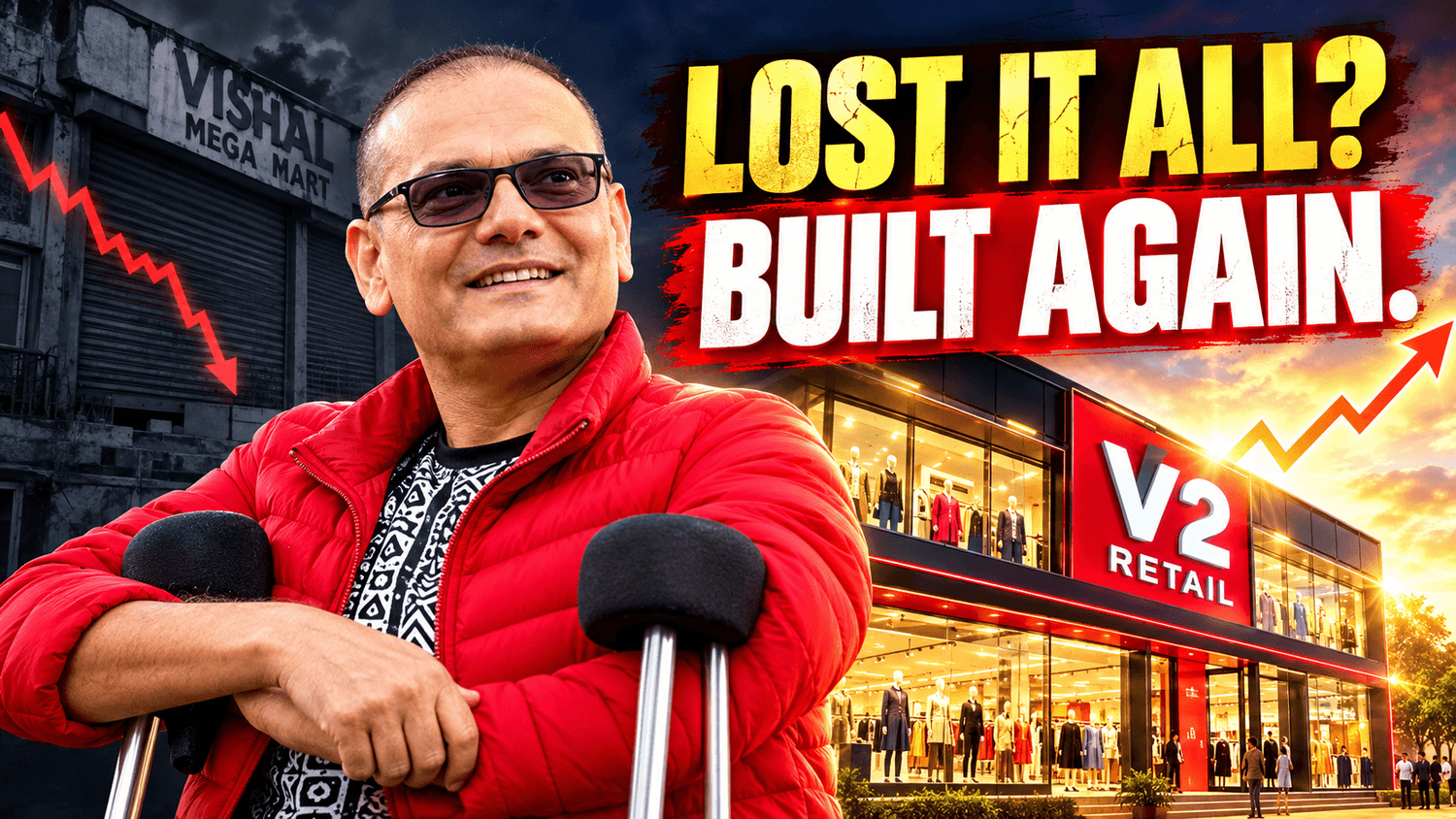
Ram Chandra Agarwal: Vishal Retail to V2 Comeback
He Built Vishal Retail. Then Lost It. The Second Chapter of Ram Chandra Agarwal
A young man in Kolkata began his business journey with a photocopy machine.
Years later, he had built a retail chain whose shares opened 75% above their issue price on the stock market.
A few years after that, the business was in debt, its operations were sold, and the name he had built was no longer his to use.
For many founders, that would have been the end of the story.
For Ram Chandra Agarwal, it became the beginning of another one.
Today, the brand that grew from his first venture, Vishal Mega Mart, and the business he went on to build, V2 Retail, have separate owners and separate journeys. To understand the remarkable connection between them, we have to return to Kolkata, long before either name appeared on a storefront.
The Boy Behind the Business
Ram Chandra Agarwal grew up facing the effects of childhood polio. His path into business began modestly, with a photocopy operation in Kolkata. There was no grand retail launch waiting around the corner. There was a young entrepreneur learning what customers needed and what they were willing to pay for.
A photocopy shop teaches its owner to pay attention.
A customer arrives with a small, immediate need. The price matters. So does speed. If the service is reliable, that customer may come back. If it is not, they can walk elsewhere.
Those lessons apply just as strongly to a clothing store.
Agarwal began his retail journey in Kolkata in the early 1990s. As he moved into garments, he saw an opportunity: families wanted clothes that looked good, but they also had household budgets to protect. A shop that offered style at accessible prices could speak to far more people than a store built only for affluent buyers. V2 Retail traces his retail journey to 1994 and his work in value retailing to 2001.
It was a simple insight. Turning it into a business would take years.
An Idea That Understood the Customer
Affordable fashion can sound like an ordinary idea now. It was powerful because it began with the customer’s real decision.
Picture a family shopping for several people at once. They might need a shirt for work, clothes for the children, and something new for a festival. They want each purchase to feel worthwhile. They also know exactly how much they can spend.
Agarwal built around that tension between aspiration and affordability.
The business associated with Vishal grew from garments into a larger value-retail format. As stores spread, its appeal reached beyond one neighbourhood or one city. Customers who could not comfortably shop at expensive fashion outlets had another option.
The growth became visible in the numbers. By the time Vishal Retail approached its 2007 initial public offering, it was operating around 50 stores. When its shares began trading that July, they opened at ₹472.50 against an issue price of ₹270: a 75% premium.
Imagine what that moment meant to the founder.
The journey that had begun with a photocopy machine had reached the stock exchange. Investors were buying into the company’s future. More stores, more customers, and more growth seemed possible.
Yet a successful listing can create a difficult question: how quickly should a promising business expand?
When Growth Became Heavy
Retail stores need money before they make money.
A company must secure space, fill shelves, hire staff, manage warehouses, and keep paying its bills while each new location finds its customers. Open many stores at once, and those commitments multiply.
Vishal Retail expanded rapidly. Then the financial crisis of 2008 changed the conditions around it. Debt became harder to manage, and the company entered a period of serious financial strain.
The pressure was substantial enough that Vishal Retail approached India’s corporate debt restructuring process in 2009. A restructuring package was approved in 2010. Its annual report records the eventual sale of its retail and other undertakings in March 2011.
It is tempting to tell this part of the story in a single dramatic sentence: he built an empire, then lost everything.
The documents show something more precise and more instructive. A business with stores, employees, customers, assets, and major liabilities had reached a point where it needed a formal restructuring and a sale.
The transaction’s stated consideration was ₹70 crore. The same annual report says the acquiring companies also took over liabilities of about ₹823 crore and assets of about ₹394 crore. The ₹70 crore figure therefore does not, by itself, describe everything involved in the deal.
The retail undertaking went to a Shriram Group company. Wholesale, institutional sales, and franchise operations went to a subsidiary connected with TPG. The “Vishal” name went with the sold business.
For Agarwal, that meant facing a question no entrepreneur wants to answer:
What do you build when the business you are known for moves forward without you?
Starting Again, Under a New Name
The answer came quickly.
Vishal Retail Limited changed its name to V2 Retail Limited in 2011. Agarwal remained involved and has served as its chairman and managing director since that year, according to the company. What followed was the development of stores under the V2 name.
The name was different. The understanding of the customer was still there.
V2 Retail concentrated on affordable clothing and other merchandise for families, with a strong presence in Tier 2 and Tier 3 markets. These were places where customers cared deeply about price but still wanted choice, quality, and a pleasant shopping experience.
A second attempt also offered a chance to apply lessons from the first. Growth mattered, but so did inventory, sourcing, store performance, and cash. A busy store was useful only if the business supporting it could remain healthy.
V2’s later annual report describes its focus on supply chains, bulk procurement, local sourcing, private-label products, and inventory management. At the end of the 2024–25 financial year, it reported 189 stores across 150 cities and revenue of ₹1,884.5 crore. Its website now reports more than 415 stores nationwide.
Those figures mark a considerable business achievement. The more compelling part is what came before them.
Agarwal did not get to restart as an unknown beginner. He restarted as someone whose earlier company’s difficulties had played out in public. Every new store stood beside the memory of the old one.
He kept building anyway.
What Happened to Vishal Mega Mart?
The original brand followed its own path after the 2011 sale.
In 2018, investors Partners Group and Kedaara Capital acquired Vishal Mega Mart. Under its later ownership, the company continued growing as a value retailer serving middle- and lower-middle-income customers. Its range came to include apparel, general merchandise, and everyday essentials.
By September 2024, its public-offering documents described a network of 645 stores across 414 cities. Vishal Mega Mart listed on Indian stock exchanges in December 2024.
This is where the two stories are often blended together.
Agarwal founded the business from which the Vishal brand grew. The brand’s later expansion and 2024 listing happened under subsequent owners. His own second chapter is V2 Retail.
Both facts matter. One recognises the idea he built. The other recognises his decision to build again.
The Kind of Courage That Lasts Longer Than a Headline
Business stories often celebrate the opening bell, the new store count, or the size of a company. Those milestones are easy to photograph.
The harder moments rarely have a photograph.
There is the day a founder realises that debt has become a threat. The day difficult terms have to be discussed. The day a familiar name leaves the business. And then there is the ordinary morning afterward, when work still has to begin.
Agarwal’s story does not suggest that determination alone can solve every financial problem. Vishal Retail’s difficulties were real. Its restructuring was real. Decisions about expansion and debt have consequences for many people, including employees, lenders, and customers.
That is why the comeback has weight.
Starting again did not erase the first company’s troubles. It required Agarwal to carry his experience into a new one: the knowledge of how to find a customer, how to offer value, and how costly growth can become when operations cannot support it.
The boy who once served customers from a small operation in Kolkata had learned to think at national scale. After the sale of Vishal’s businesses, he still had to win customers one store at a time.
The Second Chapter
Perhaps the most memorable part of this journey is that its two retail names can still be seen in India today.
Vishal Mega Mart shows how far an idea can travel, even after its founder has parted with the brand. V2 Retail shows what that founder chose to do next.
Agarwal could not return to the first day of Vishal and make every decision again. Nobody can. He could take what he had learned and make a new decision in 2011.
He chose to continue.
If you are in the middle of a setback, that is the part of his story to hold on to. The next chapter does not have to look exactly like the first. It may have a different name, a different pace, and a clearer understanding of what matters.
Sometimes the most meaningful comeback begins without a celebration or a headline.
It begins when you open the door and get back to work.

Hey, I am Sunil Chaudhary
If you're an expert, coach, trainer, or consultant who wants to build a profitable Digital Coaching Business, you're in the right place.
I believe people don't need more information; they need implementation.
That's why I've dedicated my work to helping knowledge professionals turn their expertise into a real business with proven systems, automation, and ongoing support.
My mission is simple: help you stop collecting courses, start implementing, and build a Digital Coaching Business that creates income, impact, and freedom. If you're ready to move from ideas to action and from learning to implementation, I'm here to guide you every step of the way.
Let's build your Digital Coaching Business together.


Join Digital Coach Newsletter
Live Digital Coach Funnel Challenge - Book Your Seat Now

Hi I'm Sunil Chaudhary, India's Digital Coach Business Implementation Mentor helping experts, coaches, trainers, and consultants build profitable digital coaching businesses with ongoing support.
WhatsApp +919759999231