Shocking Revelation: Is Siddharth Rajsekar Really a Coach? Here Is What I Believe
Shocking Revelation: Is Siddharth Rajsekar Really a Coach? Here Is What I Believe
An honest market-education analysis by Sunil Chaudhary
There are some names in the Indian digital education ecosystem that deserve respect.
Siddharth Rajsekar is one of them.
I want to make that absolutely clear before I make the argument in this article.
I respect Siddharth Rajsekar.
I respect the work he has done.
I respect the community he has built.
I respect his contribution to the digital knowledge economy.
And I respect him particularly in the roles of Teacher, Educator, Trainer and Community Leader.
His public profile itself highlights his work as a teacher, his extensive course creation, his large learning community and his mission around helping experts, coaches and creators build online businesses. His website currently describes him as a “digital coach” and reports 48,000+ community members, 50+ courses and 2,000+ webinars.
So this article is not an attack on Siddharth Rajsekar.
It is not about bringing someone down.
It is not about competition.
It is not about questioning his achievements.
It is about something much more important:
Can we create clarity about what the word “Coach” actually means?
Because I believe the market deserves that clarity.
The Problem Is Not Siddharth Rajsekar
The real problem is much bigger.
The word Coach has become one of the most loosely used words in the knowledge industry.
Today:
A Teacher calls himself a Coach.
A Trainer calls herself a Coach.
A Consultant calls himself a Coach.
A Course Creator calls herself a Coach.
A Community Leader calls himself a Coach.
A Motivational Speaker calls herself a Coach.
And sometimes, simply because someone has a large following, the market assumes:
“This person must be a Coach.”
But is that logically correct?
I don't think so.
And this is where I want to introduce a simple framework.
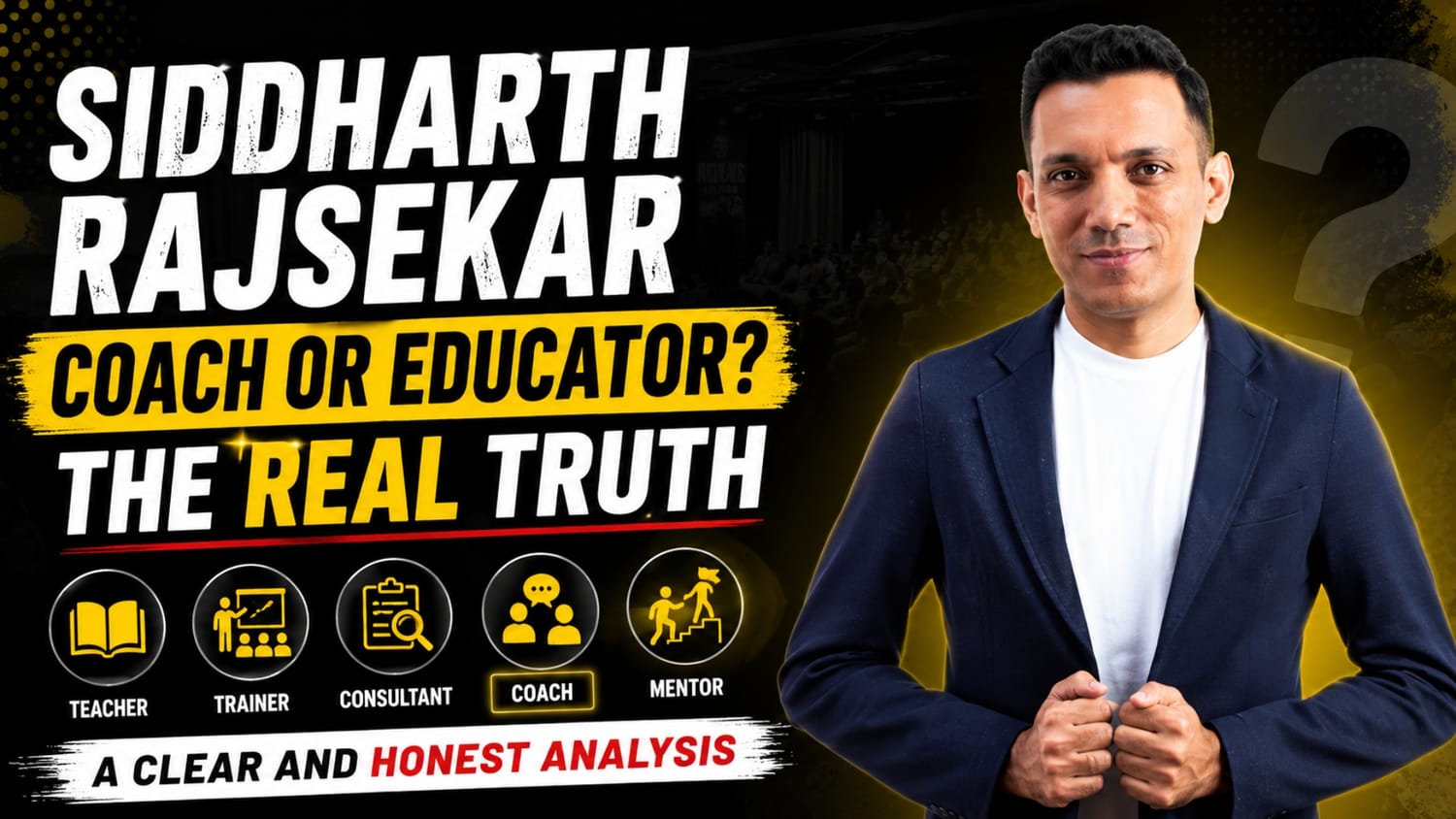
First, Let's Define the Five Roles
Before we analyse anybody, including Siddharth Rajsekar or myself, we need objective definitions.
A Teacher
A Teacher primarily gives you:
Knowledge and understanding.
The Teacher says:
“Let me explain this to you.”
A Trainer
A Trainer primarily develops:
Skills and capabilities.
The Trainer says:
“Let me show you how to do this, and now you practice.”
A Consultant
A Consultant primarily provides:
Diagnosis and recommendations.
The Consultant says:
“Let me analyse your situation and tell you what needs to change.”
A Coach
A Coach primarily facilitates:
Progress, action, accountability and development toward a desired outcome.
The Coach says:
“Let's understand where you are, where you want to go, what you need to do, what happened, and what we need to change next.”
A Mentor
A Mentor primarily provides:
Experience-based guidance and perspective.
The Mentor says:
“I have travelled this road. Based on my experience, here is what I would recommend.”
These five roles can overlap.
One professional can perform all five.
But they are not the same role.
And that is the entire point of this article.
Now Let's Look at Siddharth Rajsekar Through This Framework
I am not going to judge Siddharth based on his personality.
I am not going to judge him based on his popularity.
I am not going to judge him based on whether people love him.
I am going to look at the delivery model.
That is the only fair way to do this.
And I want to make another distinction very clearly:
I am analysing the publicly described program model, not making a claim about every private interaction Siddharth may have with every participant.
We cannot know every interaction inside a private community.
So the correct question is:
What does the publicly described model primarily deliver?
Siddharth's Greatest Strength: Education at Scale
If there is one area where I believe Siddharth Rajsekar has created enormous value, it is education at scale.
His ecosystem includes:
Courses
Webinars
Books
Podcasts
Learning resources
Communities
Masterminds
Events
Educational frameworks
His official website currently highlights 50+ courses, 2,000+ webinars and a community of more than 48,000 members.
That is not a small achievement.
That is a significant educational ecosystem.
And I have no hesitation saying:
Siddharth Rajsekar is an extremely influential Teacher and Educator in the digital business ecosystem.
He has helped thousands of people learn about:
Digital marketing
Personal branding
Online business
Coaching business
Content
Funnels
Community building
Digital products
Knowledge monetisation
That is education.
And education matters.
Teacher Is Not a Small Title
I want to make this point very strongly.
Sometimes people think:
“If someone is called a Teacher instead of a Coach, it somehow reduces their status.”
Absolutely not.
A great Teacher can change thousands of lives.
A great Teacher can create movements.
A great Teacher can create entrepreneurs.
A great Teacher can create future Coaches.
A great Teacher can create future Mentors.
Teacher is a powerful profession.
So if I say that Siddharth's primary strength is education, I am not insulting him.
I am actually recognising one of his biggest strengths.
Then Comes Training
A lot of digital education also involves training.
You don't simply learn:
“What is a funnel?”
You may learn:
“How to build a funnel.”
You may learn:
How to create a landing page
How to create content
How to structure an offer
How to conduct webinars
How to build a community
How to create digital products
This moves from pure education toward training.
And again, that's valuable.
Training answers:
“Can you do it?”
Then Comes Community Leadership
This is another area where Siddharth has clearly built a significant presence.
His current website describes a community of 48,000+ members, and his broader ecosystem is heavily centred around community, learning networks and knowledge entrepreneurs.
That makes Community Leadership a major part of the model.
And community leadership is a real professional function.
A Community Leader:
Creates an environment
Sets culture
Brings people together
Creates shared identity
Organises experiences
Creates learning opportunities
Encourages participation
Celebrates achievements
Builds networks
This is powerful.
And I genuinely respect Siddharth for building this at scale.
But Is Community Leadership the Same as Coaching?
No.
A Community Leader can create a fantastic environment for growth without personally coaching every member.
Imagine a community of 50,000 people.
The leader creates:
Events
Content
Challenges
Sessions
Networking
Learning
Recognition
Peer interaction
Thousands of people may transform because of the ecosystem.
But that does not mean the leader personally coaches every individual.
And there is nothing wrong with that.
Influence is not the same as individual coaching.
This Is Where the Word “Coach” Becomes Complicated
Siddharth's official website explicitly calls him a Digital Coach.
I respect his right to use that positioning.
But as a market analyst, I want to ask a deeper question:
What does the participant actually experience as coaching?
Because there is a difference between:
Being taught by a Coach
and
Being personally coached by a Coach.
These are not necessarily the same thing.
Imagine a 2,000-Person Session
Let's take a hypothetical example.
Suppose 2,000 people attend a live session.
The expert teaches:
“Here is how to identify your niche.”
Then:
“Here is how to build your offer.”
Then:
“Here is how to create content.”
Then:
“Here is how to sell.”
Everyone receives the same framework.
That is valuable.
But what is it?
It is primarily:
Teaching + Training.
Now imagine three participants are brought onto a Hot Seat.
Their individual situations are analysed.
Specific recommendations are given.
That's a coaching or consulting intervention for those participants.
But the remaining 1,997 people are primarily learning by observation.
That distinction is critical.
Watching Coaching Is Not the Same as Receiving Coaching
This is one of the biggest misunderstandings in the coaching industry.
If I watch someone else get coached, I can learn enormously.
But I have not necessarily been personally coached.
For example:
If a doctor examines another patient in front of me, I can learn something.
But I have not received a medical examination.
If a lawyer analyses another person's case, I can learn something.
But that does not mean the lawyer has analysed my case.
Similarly:
Watching someone else receive a Hot Seat does not automatically mean I have received individual coaching.
This is not criticism.
It is simply a distinction.
The Real Question: How Much Personal Intervention?
This is where I believe consumers should become smarter.
Don't ask:
“Is this a coaching program?”
Ask:
“How much personal intervention is actually included?”
Ask:
Who knows my business?
Who reviews my implementation?
Who sees my actual work?
Who knows my numbers?
Who tracks my progress?
Who gives me personal feedback?
Who challenges my decisions?
Who follows up?
Who helps me course-correct?
These questions reveal the actual depth of coaching.
The Difference Between Information and Intervention
This is perhaps my favourite distinction.
Information:
“Here is what you should do.”
Intervention:
“I saw what you did. Here is what is wrong. Here is what you need to change. Come back after implementing it. Let's review the result.”
Information is scalable.
Intervention is much harder to scale.
And coaching becomes increasingly powerful when intervention increases.
This Is Why I Respect the Teacher Role
Siddharth's model has demonstrated the power of information and education at scale.
And his own public content recognises that the knowledge economy needs to evolve beyond simply giving people information. In a 2024 podcast, he explicitly discussed the limitations of course-based models and argued for accountability, mentorship, continuous engagement and community-based approaches.
I actually agree with that philosophy.
Knowledge alone is not enough.
People need:
Knowledge + Action + Accountability + Community + Feedback.
The question is how deeply those elements are delivered to each individual participant.
What About Diamond?
Here I want to be particularly fair.
I cannot honestly write:
“Siddharth never mentors people.”
That would be factually irresponsible.
His current official Diamond page explicitly says:
“This is where you can get personally mentored by Siddharth Rajsekar on a weekly basis.”
It also lists:
Weekly LIVE Audit Calls.
Therefore, the fair conclusion is not:
“There is no mentoring or coaching anywhere in the ecosystem.”
There clearly are offerings that describe personal mentorship and audit interaction.
The more precise question is:
How much of the overall Silver, Gold and Diamond experience is personalised coaching versus education, training, community and group learning?
That is a legitimate consumer question.
My Strict Interpretation of the Model
Under the framework I have developed in this series, I would classify the dominant functions of a large-scale digital knowledge ecosystem like this:
Teacher / Educator
Very strong.
Large-scale knowledge delivery, courses, webinars, frameworks and educational content.
Trainer
Strong.
Practical frameworks and systems that people can implement.
Community Leader
Very strong.
A large community, events, shared identity, networking and collective learning.
Consultant
Present in selected interactions.
Where specific businesses or situations are analysed and recommendations are provided.
Coach
Depends heavily on the specific program and level of individual interaction.
Mentor
Present where there is genuine personal, experience-based guidance and ongoing interaction.
This is a much more nuanced conclusion than simply saying:
“He is not a Coach.”
So Why Does My Headline Say “Siddharth Rajsekar Is Not a Coach”?
Because headlines are designed to create curiosity.
But the article must deliver nuance.
And my actual argument is more specific:
If we define coaching in a strict, high-touch, individually contextualised sense, then large-scale education and community participation should not automatically be labelled as personal coaching.
That distinction applies to every Coach in the industry.
Including me.
I Am Not Putting Siddharth Down
Let me say this from the heart.
Siddharth, I respect your work.
You have built something significant.
You have educated thousands of people.
You have built a large community.
You have created courses.
You have written books.
You have created frameworks.
You have helped build awareness around the digital knowledge business.
And I genuinely believe:
You are doing excellent work as a Teacher, Educator, Trainer and Community Leader.
That is not an insult.
That is my recognition of your strengths.
My disagreement is only with the strict definition and interpretation of professional roles.
And I believe healthy disagreement is good for an industry.
And I Apply the Same Standard to Myself
This is where I want to be completely transparent.
If I call myself a Digital Coach Business Mentor, then you have every right to ask me:
“Sunil, how exactly are you coaching me?”
Don't accept my title.
Test my delivery.
Ask me:
Do you know my situation?
Do you know what I am implementing?
Do you review my work?
Do you know my results?
Do you hold me accountable?
Do you give me specific feedback?
Do you help me course-correct?
If I cannot demonstrate those things, then you should question whether I am actually coaching you.
And I welcome that scrutiny.
Because:
A professional title should be earned through professional delivery.
The Market Needs Better Questions
I don't want people to ask:
“Who is the biggest Coach?”
I want them to ask:
“What kind of support do I actually need?”
If you need knowledge:
Find a Teacher.
If you need a skill:
Find a Trainer.
If you have a specific problem:
Find a Consultant.
If you need ongoing progress and accountability:
Find a Coach.
If you need experience-based direction:
Find a Mentor.
And if you need all five?
Find a professional or ecosystem that can genuinely provide all five.
Don't Buy the Title. Buy the Delivery.
This is the biggest lesson I want readers to take away.
Before buying any program, ask:
What exactly am I buying?
Is it:
Recorded Education?
Live Training?
Community Membership?
Consulting?
Group Coaching?
One-to-One Coaching?
Mentorship?
Mastermind?
Or some combination?
Then ask:
How much personal attention is included?
That one question can save you a lot of confusion.
The Coaching Industry Needs This Clarity
I believe the future of coaching will not be won by the person with the loudest title.
It will be won by the professional who can create:
Context.
Clarity.
Action.
Accountability.
Feedback.
Implementation.
Measurement.
Course Correction.
Transformation.
That's what the next generation of coaching should be about.
My Final Verdict
So, am I saying:
“Siddharth Rajsekar has no value?”
Absolutely not.
Am I saying:
“Siddharth has never coached anyone?”
No.
His current Diamond offering explicitly describes weekly personal mentorship and weekly live audit calls, so that statement would be unfair.
Am I saying:
“His entire ecosystem is nothing but recorded courses?”
No.
His ecosystem clearly includes live sessions, communities, events, courses, audits and higher-level offerings.
What am I saying?
I am saying:
When we look at the large-scale delivery model through a strict professional framework, a substantial part of the value being delivered is education, training and community leadership.
And I believe Siddharth is excellent in those roles.
Where personalised coaching or mentoring exists, it should be evaluated based on the actual level of:
Context + Interaction + Accountability + Feedback + Implementation Review + Progress + Course Correction.
That's the standard.
Not the title.
The Bigger Truth
This article is not really about Siddharth Rajsekar.
It is about all of us.
It is about me.
It is about you.
It is about every Coach, Mentor, Trainer, Consultant, Educator and Community Leader in this industry.
We need to stop asking:
“What do you call yourself?”
And start asking:
“What do you actually do for the person who pays you?”
Because at the end of the day:
Teacher gives knowledge.
Trainer develops capability.
Consultant provides diagnosis and solutions.
Coach facilitates progress and accountability.
Mentor provides experience-based direction.
Community Leader creates the environment in which people can learn, connect and grow.
And one person can absolutely be all of these.
But we should be honest about which role we are performing at any given moment.
That is not criticism.
That is professionalism.
That is market education.
And ultimately, that is how we build a better, more transparent and more trustworthy coaching industry.
My Respectful Closing
Siddharth Rajsekar, I genuinely respect the work you are doing.
If you are reading this, please understand the spirit behind this article.
I am not trying to diminish your contribution.
I am trying to make the market more intelligent about professional definitions.
You have created a significant educational and community ecosystem.
I appreciate that.
And I believe there is enough room in Bharat's knowledge economy for many successful educators, trainers, consultants, Coaches, Mentors and community leaders.
Competition is temporary.
Professional standards are permanent.
And if this discussion makes even one buyer ask better questions before investing in a program, then this article has served its purpose.
Respect the person.
Analyse the model.
Question the terminology.
Choose the service that actually matches your need.
That is the clarity I wanted to create.
Sunil Chaudhary
Digital Coach Business Mentor
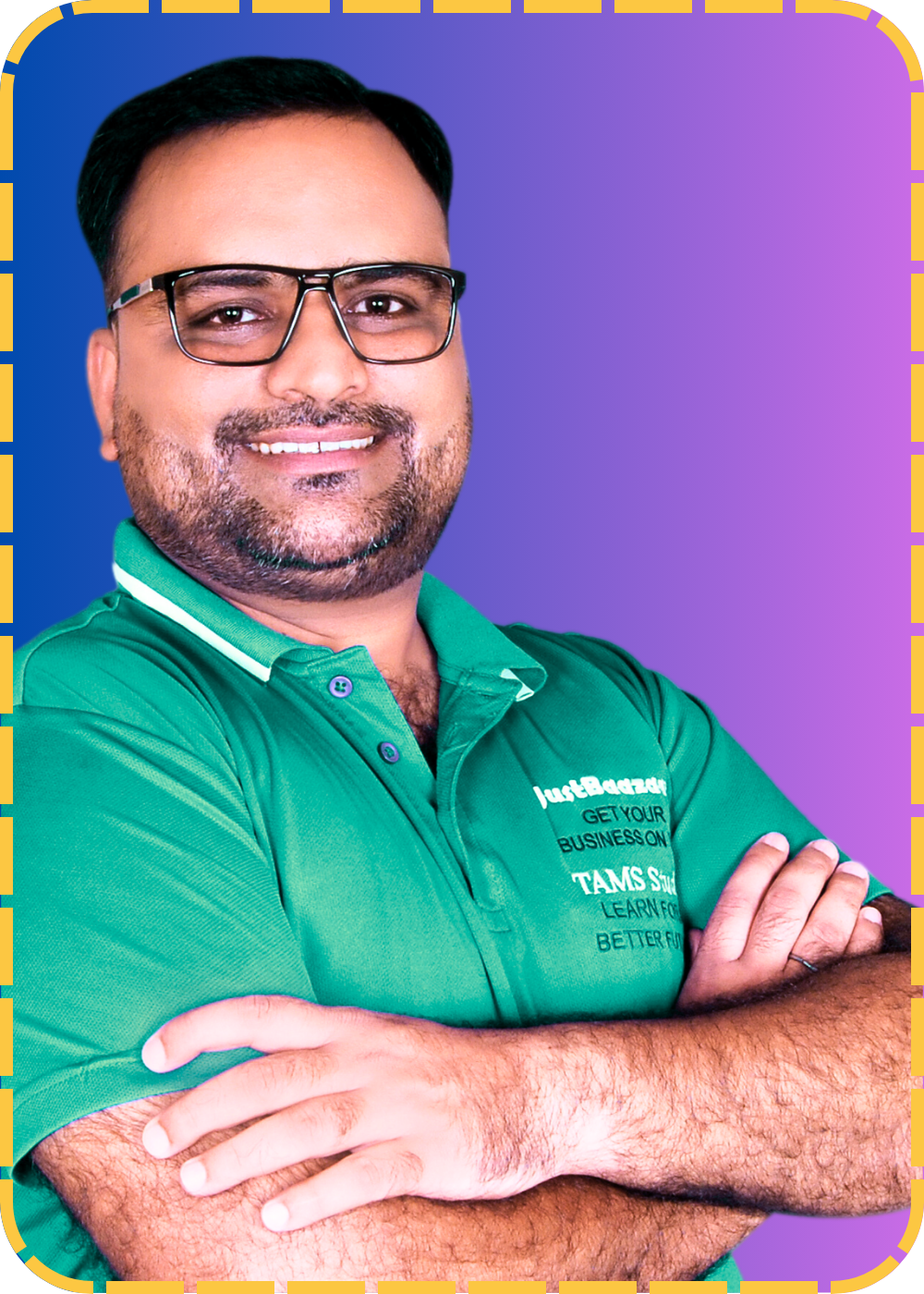
Hey, I am Sunil Chaudhary
If you're an expert, coach, trainer, or consultant who wants to build a profitable Digital Coaching Business, you're in the right place.
I believe people don't need more information; they need implementation.
That's why I've dedicated my work to helping knowledge professionals turn their expertise into a real business with proven systems, automation, and ongoing support.
My mission is simple: help you stop collecting courses, start implementing, and build a Digital Coaching Business that creates income, impact, and freedom. If you're ready to move from ideas to action and from learning to implementation, I'm here to guide you every step of the way.
Let's build your Digital Coaching Business together.


Join Digital Coach Newsletter
Live Digital Coach Funnel Challenge - Book Your Seat Now
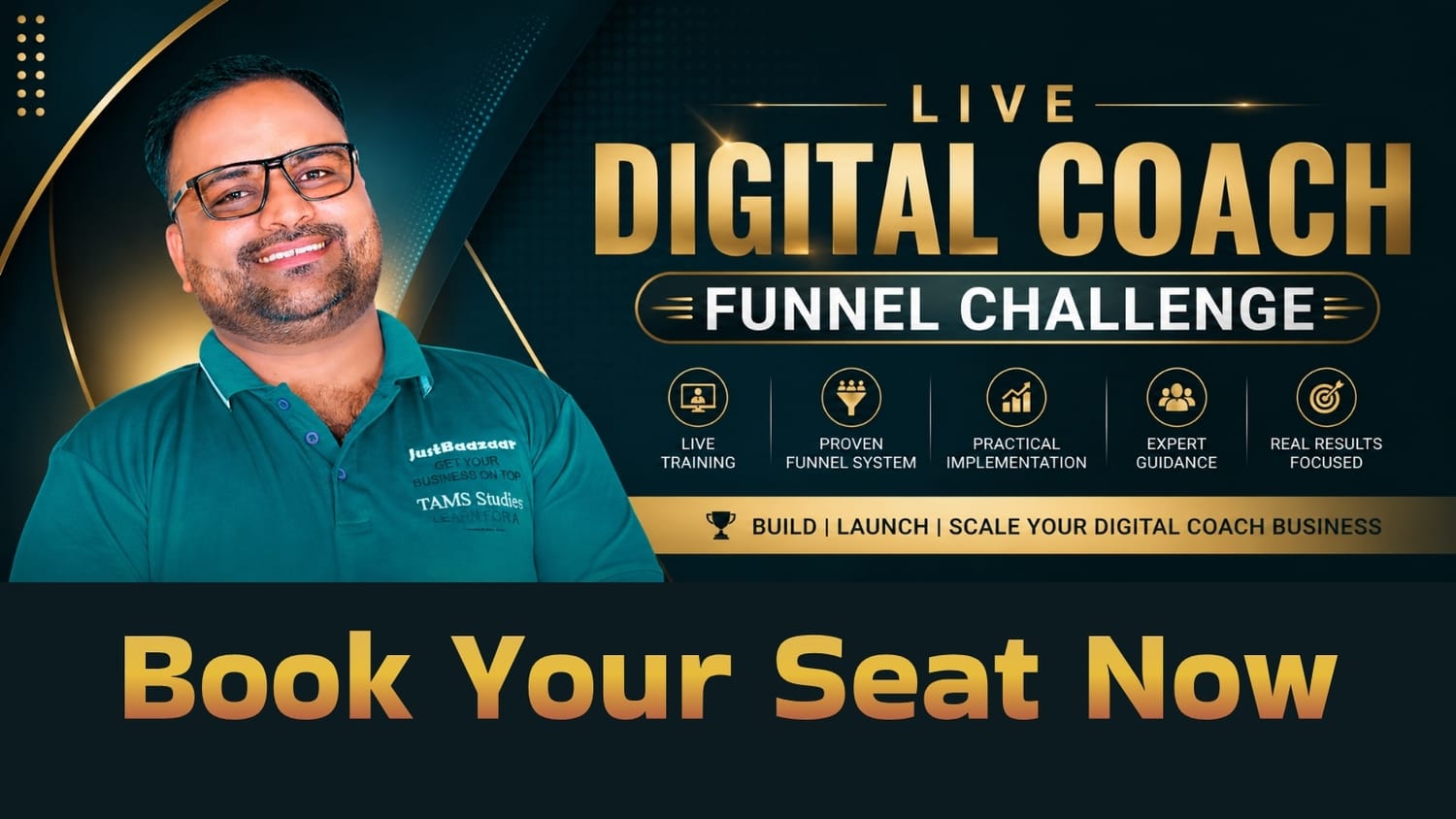
Hi I'm Sunil Chaudhary, India's Digital Coach Business Implementation Mentor helping experts, coaches, trainers, and consultants build profitable digital coaching businesses with ongoing support.
WhatsApp +919759999231